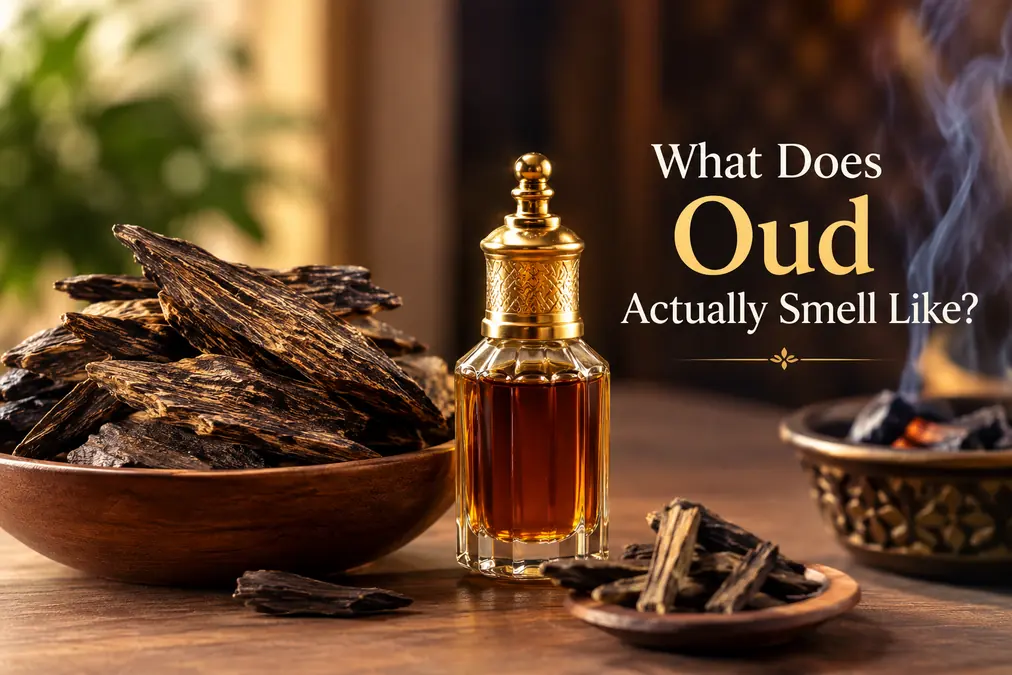
What Does Oud Actually Smell Like? A Scent Guide
What Does Oud Actually Smell Like?
What Does Oud Actually Smell Like? A Scent Guide is a question many fragrance lovers ask before buying their first oud oil, oud perfume, or agarwood. The answer is more complicated than simply saying “woody” or “smoky.”
Oud can smell dark, woody, smoky, earthy, leathery, sweet, spicy, resinous, medicinal, musky, or slightly animalic. Some oud oils are surprisingly soft and creamy, while others can be powerful enough to dominate an entire room.
This huge variation is what makes oud so fascinating.
If you have only smelled modern perfumes marketed as “oud,” you may be surprised when you experience genuine oud oil or agarwood incense. Natural oud can have a much more complex and unpredictable character.
In this What Does Oud Actually Smell Like? A Scent Guide, we’ll explore the different smells associated with oud, why oud oils vary so much, how natural and synthetic oud compare, and what you should expect when smelling oud for the first time.
What Does Oud Actually Smell Like?
There is no single smell that represents every oud.
Oud is closely associated with agarwood, a fragrant resinous wood that develops in certain trees, particularly species of Aquilaria and related genera. When resinous agarwood is processed, it can be distilled into oud oil or used as incense.
The resulting scent depends on many factors, including:
- Tree species
- Geographic origin
- Resin formation
- Agarwood quality
- Harvesting
- Distillation method
- Distillation duration
- Aging
- Storage
- Blending
This is why two bottles labeled “natural oud” can smell completely different.
One might smell sweet and fruity, while another smells dark, smoky, leathery, and medicinal.
So, What Does Oud Actually Smell Like? A Scent Guide cannot have just one simple answer. Oud is better understood as a broad family of complex woody and resinous aromas.
The Main Smells You May Notice in Oud
When trying to understand What Does Oud Actually Smell Like? A Scent Guide, it helps to break the aroma into individual characteristics.
Here are some of the most common oud scent profiles.
1. Woody
The woody character is usually the easiest place to start.
Oud can smell like deep, dark, resinous wood rather than the clean woody aroma found in many modern fragrances.
Depending on the oil, you may notice:
- Dry wood
- Dark wood
- Resinous wood
- Warm wood
- Slightly bitter wood
- Damp wood
The woody character gives oud its foundation, but it rarely tells the whole story.
2. Smoky
Smoke is another important part of traditional agarwood fragrance.
When agarwood chips are burned as incense, the smoke creates an intense combination of woody, resinous, warm, and slightly sweet aromas.
This smoky character is particularly familiar in Middle Eastern fragrance culture, where burning oud is traditionally associated with homes, gatherings, hospitality, and special occasions.
However, not every oud oil smells strongly smoky.
A distilled oud oil may contain little of the smoky character associated with burning agarwood.
3. Earthy
Some oud oils have a deep earthy quality.
This can remind you of:
- Damp soil
- Forest floors
- Wet wood
- Moss
- Dark natural resins
For people who enjoy natural and unusual fragrances, this earthy character can make oud feel authentic and organic.
When asking What Does Oud Actually Smell Like? A Scent Guide, earthy is one description that should not be ignored.
4. Leathery
A leathery smell is common in many darker oud profiles.
It can feel warm, dry, slightly smoky, and luxurious.
This is one reason oud works so well with leather, saffron, amber, rose, musk, and spicy notes in perfume compositions.
A leathery oud can feel particularly rich when used in an evening fragrance.
5. Sweet
Not all oud is sweet, but some varieties have beautiful sweet characteristics.
The sweetness can appear as:
- Honey
- Dried fruit
- Balsamic sweetness
- Creamy sweetness
- Soft resin
- Warm sugary nuances
Sweet oud is often easier for beginners because it can feel smoother and less challenging than highly medicinal or animalic varieties.
6. Medicinal
One of the most surprising characteristics of some natural oud is its medicinal smell.
A particular oud may remind you of:
- Camphor
- Herbs
- Medicine
- Antiseptic-like aromas
- Sharp aromatic woods
This doesn’t automatically mean the oud is fake or poor quality.
Certain natural oud oils genuinely have medicinal or camphoraceous characteristics.
For someone experiencing natural oud for the first time, this can be unexpected.
7. Animalic
Some traditional oud oils contain animalic characteristics.
They may smell:
- Musky
- Warm
- Skin-like
- Fermented
- Funky
- Slightly wild
This style is not necessarily designed to smell “clean.” Instead, it can provide depth and natural complexity.
Some experienced oud collectors specifically appreciate these characteristics.
What Does Natural Oud Smell Like?
Natural oud can be extremely complex because it comes from naturally occurring resinous agarwood rather than a single aroma molecule.
A high-quality natural oud oil may move through several different impressions during wear.
At first, it might smell sharp and medicinal.
After several minutes, the medicinal character may soften and reveal woods, leather, sweetness, or spices.
Later, the dry-down may become smoother, warmer, musky, or slightly creamy.
This changing character is one of the most interesting parts of What Does Oud Actually Smell Like? A Scent Guide.
Natural oud is not necessarily smooth from beginning to end. Its character can evolve considerably.
What Does Oud Oil Smell Like?
Oud oil is usually much more concentrated than an ordinary oud perfume.
When you open a bottle, the first impression can be intense.
Depending on the oil, you may smell:
Opening:
Sharp wood, smoke, medicine, earth, or spices.
Heart:
Leather, resin, warm wood, sweetness, or floral nuances.
Dry-down:
Musk, soft wood, amber-like warmth, earth, or creamy sweetness.
However, this is only a general example.
There is no universal oud oil scent journey.
Some oils are sweet immediately. Others remain medicinal for hours. Some are extremely smoky, while others are surprisingly clean and smooth.
Therefore, when researching What Does Oud Actually Smell Like? A Scent Guide, remember that descriptions are useful starting points rather than strict rules.
What Does Oud Perfume Smell Like?
Oud perfume can smell completely different from pure oud oil.
Many modern fragrances use an oud accord rather than relying entirely on natural oud oil.
Perfume makers may combine oud-style materials with:
- Rose
- Saffron
- Amber
- Vanilla
- Musk
- Sandalwood
- Patchouli
- Citrus
- Leather
- Spices
- Floral notes
This can create a smoother and more accessible interpretation of oud.
For example, a rose oud perfume may smell more floral and sweet than woody.
A saffron oud fragrance may feel warm and spicy.
An amber oud perfume may smell rich, sweet, and resinous.
This is why simply smelling a perfume labeled “oud” doesn’t necessarily tell you what genuine oud oil smells like.
Natural Oud vs Synthetic Oud
A major part of What Does Oud Actually Smell Like? A Scent Guide is understanding the difference between natural oud and synthetic oud accords.
Natural Oud
Natural oud comes from resinous agarwood and can display a broad range of characteristics.
It may smell:
- Complex
- Earthy
- Woody
- Smoky
- Leathery
- Medicinal
- Animalic
- Sweet
- Resinous
Its aroma can also vary from batch to batch.
Synthetic Oud
Synthetic oud accords are created using aroma materials designed to produce certain oud-like characteristics.
They can be:
- Consistent
- Smooth
- Powerful
- Woody
- Sweet
- Modern
- Predictable
A synthetic oud accord may be designed to avoid some of the challenging characteristics associated with traditional natural oud.
This doesn’t mean every synthetic oud smells the same. Different perfume formulas can produce dramatically different results.
Why Does Oud Smell Different From One Bottle to Another?
If you’ve ever compared several oud oils, you may have noticed that they don’t smell alike.
There are several reasons.
Geographic Origin
Oud from different regions can have different aromatic characteristics.
Cambodian, Indian, Malaysian, Thai, Indonesian, and other regional oud profiles may show different combinations of sweetness, earthiness, smoke, leather, fruitiness, and wood.
Tree Species
Different species and related genera can produce different aromatic materials.
Resin Formation
The quality and amount of resinous material in the wood can significantly influence the resulting aroma.
Distillation
The distillation process can change the character of oud oil.
Temperature, equipment, water, duration, wood preparation, and distillation technique can all influence the final product.
Aging
Some oud oils change with age.
An oil that initially smells sharp may become smoother, deeper, or more integrated over time.
What Does Cambodian Oud Smell Like?
Cambodian oud is often associated with sweet, fruity, woody, and resinous characteristics.
Some Cambodian-style oils can feel relatively smooth and approachable.
You may notice impressions of:
- Dried fruit
- Sweet wood
- Warm resin
- Soft earth
- Balsamic sweetness
However, Cambodian oud is not one fixed scent profile.
Individual oils can differ significantly based on the wood and production method.
What Does Indian Oud Smell Like?
Indian oud is often associated with a darker and more traditional profile.
It may contain:
- Earthy notes
- Leather
- Smoke
- Spices
- Medicinal nuances
- Animalic characteristics
- Dark woods
Some Indian oud oils can be very powerful and challenging for beginners.
Others can be smoother and more refined.
This variation is another reason What Does Oud Actually Smell Like? A Scent Guide cannot give one universal answer for an entire region.
What Does Malaysian Oud Smell Like?
Malaysian oud can show woody, earthy, green, smoky, spicy, or slightly sweet characteristics.
The final scent depends heavily on the particular source, wood quality, species, and distillation method.
Some oils may smell fresh and green, while others can become darker and more resinous.
What Does Oud Incense Smell Like?
Burning agarwood creates an experience that is very different from applying oud oil.
When heated, agarwood releases aromatic smoke that can fill an entire room.
The scent can feel:
- Deep
- Smoky
- Woody
- Sweet
- Resinous
- Warm
- Earthy
High-quality agarwood can produce a smooth and luxurious aroma.
This traditional use of oud is especially important across the Gulf region, including Kuwait, Saudi Arabia, Qatar, Bahrain, Oman, and the UAE.
Why Does Oud Smell Strange to Some People?
If you’re new to oud, don’t be surprised if your first experience is confusing.
Traditional oud doesn’t always smell like the fresh, clean, fruity perfumes that dominate modern fragrance counters.
Some oud can initially smell:
- Medicinal
- Bitter
- Smoky
- Animalic
- Earthy
- Extremely woody
This can make it difficult for beginners to appreciate immediately.
But after smelling several varieties, you may begin to identify individual characteristics.
Instead of thinking, “I don’t like oud,” you may eventually realize that you simply prefer a particular type of oud scent.
Does Oud Smell the Same on Everyone?
No.
Skin chemistry can change the way oud develops.
Factors such as:
- Skin temperature
- Humidity
- Natural skin oils
- Application amount
- Other skincare products
- Fragrance formulation
can affect the final aroma.
This is particularly important when purchasing expensive oud oil.
If possible, test a sample on your own skin before purchasing a large bottle.
How to Smell Oud Correctly
If you’re trying to understand What Does Oud Actually Smell Like? A Scent Guide, don’t judge an oud immediately.
Try this simple process:
Step 1: Smell the Bottle
Take a gentle sniff without repeatedly inhaling deeply.
Notice the first impression.
Step 2: Apply a Small Amount
Put a tiny amount on your wrist or another suitable area.
Step 3: Smell Immediately
This gives you the opening character.
Step 4: Wait
Give the fragrance around 15–30 minutes.
Notice what changes.
Step 5: Check the Dry-Down
After several hours, smell the area again.
The dry-down may be dramatically different from the opening.
Step 6: Compare
Try another oud on a different day or on a separate area.
This makes it easier to understand the differences.
Does Oud Smell Good?
Whether oud smells good is ultimately personal.
One person may love deep, smoky, animalic oud, while another may prefer sweet and creamy oud.
Someone who enjoys fresh citrus fragrances may find traditional oud intense.
Another person may find that same oud luxurious and fascinating.
The important thing is to identify the oud characteristics you personally enjoy.
Does Oud Smell Expensive?
Oud is often associated with luxury because high-quality agarwood and oud oil can be rare and expensive.
However, price does not create a particular smell.
A costly oud may smell:
- Sweet
- Earthy
- Medicinal
- Smoky
- Animalic
- Woody
The price and scent profile are separate considerations.
When buying oud, evaluate the actual aroma rather than assuming a higher price automatically means a smell you will prefer.
Is Oud Suitable for Beginners?
Yes, but beginners may want to start with softer oud fragrances.
A beginner-friendly oud perfume may combine oud with:
- Rose
- Vanilla
- Amber
- Sandalwood
- Musk
- Citrus
- Soft florals
These combinations can make the fragrance easier to understand.
Highly concentrated traditional oud oil can be much more intense and may require more experience to appreciate.
How Long Does Oud Smell Last?
Oud can have excellent longevity, but performance varies.
It depends on:
- Oil concentration
- Perfume formulation
- Skin chemistry
- Climate
- Application amount
- Ingredients
- Product quality
Pure oud oil can remain detectable for many hours, while an oud perfume may perform differently depending on its concentration and formula.
In hot Gulf climates, fragrance can also project differently from how it behaves in colder weather.
Oud Scent Guide: The Quick Breakdown
If you want a simple way to understand What Does Oud Actually Smell Like? A Scent Guide, use this chart:
| Oud Character | What It May Remind You Of |
|---|---|
| Woody | Dark, warm timber |
| Smoky | Burning agarwood |
| Earthy | Forest floor and damp wood |
| Leathery | Warm leather |
| Sweet | Honey, fruit, or resin |
| Medicinal | Camphor or aromatic herbs |
| Animalic | Musk or warm skin |
| Spicy | Saffron, pepper, or aromatic spices |
| Balsamic | Warm, sweet resin |
| Creamy | Soft woods and smooth resins |
Remember that one oud may contain several of these characteristics simultaneously.
Frequently Asked Questions
What Does Oud Actually Smell Like?
What Does Oud Actually Smell Like? A Scent Guide usually describes oud as a complex combination of woody, smoky, earthy, leathery, resinous, sweet, medicinal, spicy, or animalic aromas. The exact smell depends on the source and production method.
Is oud supposed to smell like medicine?
Some natural oud can have a medicinal or camphoraceous smell. This is a recognized characteristic of certain oud oils and doesn’t automatically indicate that the oil is fake.
Does oud smell like wood?
Yes. Oud normally has a woody foundation, but natural oud can also contain smoky, earthy, leathery, sweet, resinous, and animalic characteristics.
Is oud sweet or smoky?
It can be either. Some oud is predominantly sweet and fruity, while other varieties are smoky, earthy, leathery, or medicinal.
Why does oud smell different on my skin?
Skin chemistry, body temperature, humidity, application amount, and the perfume formula can all influence how oud develops.
What does natural oud smell like compared with perfume oud?
Natural oud can be more complex, irregular, earthy, medicinal, smoky, or animalic. Modern oud perfumes may use oud accords that create smoother, sweeter, cleaner, or more predictable interpretations.
Which oud smells the sweetest?
Some Cambodian-style oud oils are often associated with sweeter and fruitier characteristics, but sweetness varies considerably between individual oils.
Why is oud so popular in the Gulf?
Oud has a long cultural and fragrance tradition across the Gulf region. Agarwood incense, oud oil, and oud-based perfumes are commonly associated with hospitality, special occasions, traditional fragrance, and luxury.
Final Thoughts
So, What Does Oud Actually Smell Like? A Scent Guide ultimately leads to one important conclusion: oud does not have one universal smell.
It can be dark and smoky, sweet and fruity, earthy and leathery, medicinal and sharp, or smooth and creamy. The experience depends on the agarwood source, resin, species, origin, distillation, aging, formulation, and your own skin chemistry.
For beginners, the biggest mistake is expecting every oud to smell the same.
Instead, explore different styles.
Try a sweet oud, then a smoky one. Compare a traditional oud oil with a modern oud perfume. Smell agarwood incense and notice how different the smoky aroma can be from distilled oil.
Once you begin identifying these individual characteristics, oud becomes much easier to understand.
And that is the real answer to What Does Oud Actually Smell Like? A Scent Guide: oud is not simply a smell of wood. It is a broad and evolving fragrance experience that can move between wood, smoke, earth, leather, resin, sweetness, spice, medicine, and musk—sometimes all within the same fragrance.