
Oud Perfume Notes Explained: Top, Middle and Base
Oud perfume notes can completely change the way a fragrance smells from the first spray to the final dry-down. One oud perfume may open with bright citrus and spices, develop into a warm floral heart, and eventually settle into a deep woody base. Another may smell smoky, leathery, sweet, earthy, or resinous from beginning to end.
Understanding oud perfume notes makes it much easier to choose a fragrance that matches your taste, occasion, climate, and personality. Instead of judging a perfume only by its first spray, you can understand how its scent is designed to develop over time.
This guide explains the fragrance pyramid in simple terms, including top notes, middle notes, and base notes, and shows how oud fits into each stage.
What Are Oud Perfume Notes?
Oud perfume notes are the individual scent impressions or ingredients used to create the overall character of an oud fragrance. They can include natural materials, aroma molecules, essential oils, extracts, resins, woods, spices, flowers, fruits, and other fragrance ingredients.
Perfume makers arrange these materials so that different aromas become noticeable at different stages.
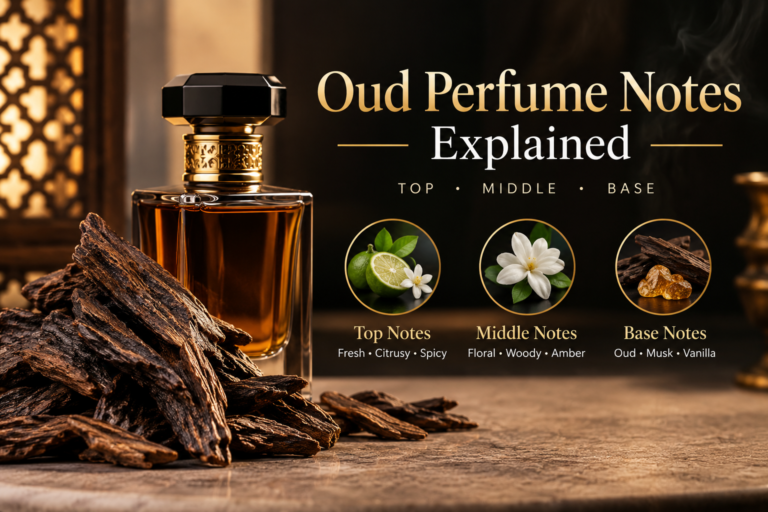
The traditional fragrance pyramid has three main levels:
- Top notes – the opening impression
- Middle notes – the heart of the fragrance
- Base notes – the long-lasting foundation
However, this does not mean every fragrance changes in three perfectly separated stages. Fragrance development is gradual, and different ingredients can overlap.
When you understand oud perfume notes, you can better predict how an oud fragrance may smell after 5 minutes, 1 hour, or several hours.
The Oud Perfume Fragrance Pyramid
The fragrance pyramid is a simple way to visualize how oud perfume notes develop.
| Fragrance stage | When you notice it | Common examples | Main purpose |
|---|---|---|---|
| Top notes | First few minutes | Bergamot, lemon, saffron, spices | Creates the opening |
| Middle notes | After the opening | Rose, jasmine, lavender, cinnamon | Gives the fragrance its character |
| Base notes | Later dry-down | Oud, amber, musk, sandalwood, vanilla | Provides depth and longevity |
Not every perfume uses the same ingredients or follows the same development. Some oud fragrances are especially linear, meaning they maintain a similar character throughout their wear.
Now let’s examine each level in detail.
Oud Perfume Top Notes: The First Impression
Top notes are the scents you usually notice immediately after applying an oud perfume. They are generally made from materials that evaporate relatively quickly.
Common oud perfume notes used in the opening include:
- Bergamot
- Lemon
- Mandarin
- Orange
- Saffron
- Cardamom
- Pink pepper
- Black pepper
- Ginger
- Green notes
These ingredients can make an oud fragrance feel fresh, bright, spicy, or energetic before the deeper materials become more noticeable.
Why Are Top Notes Important?
The opening is often the first thing you experience when testing a perfume. It can strongly influence your first impression.
For example, a fragrance containing bergamot and saffron may initially feel brighter and more vibrant than a perfume that opens primarily with smoky woods and resins.
This is why judging oud perfume notes immediately after spraying can sometimes be misleading.
The opening may last only a short period before the heart begins to appear.
Popular Fresh Oud Openings
In hot climates such as Kuwait and other Gulf countries, fresh citrus and aromatic openings can create an interesting contrast with rich woody ingredients.
A perfume might combine:
Bergamot + saffron + oud
or:
Citrus + spices + rose + oud
The result can feel fresher than an extremely dense, resinous oud composition.
Oud Perfume Middle Notes: The Heart of the Fragrance
Middle notes are often called the heart notes because they provide much of the fragrance’s central character.
After the initial opening begins to fade, these oud perfume notes become more prominent.
Common middle notes include:
- Rose
- Jasmine
- Geranium
- Lavender
- Cinnamon
- Nutmeg
- Orris
- Ylang-ylang
- Fruity accords
- Aromatic herbs
Oud is particularly interesting at this stage because it can interact with floral, spicy, fruity, and woody ingredients.
Oud and Rose
Rose and oud are one of the most recognizable combinations in Middle Eastern perfumery.
Rose can add a soft, floral character while oud contributes woody, resinous, smoky, or earthy facets.
Depending on the formulation, the result can range from sweet and elegant to dark and intense.
Oud and Saffron
Saffron can give an oud composition a warm, spicy, slightly leathery character.
When combined with woods and amber, saffron can create a rich fragrance profile that is particularly popular in luxury-style oud perfumes.
Oud and Floral Notes
Not every oud fragrance needs to smell extremely dark.
Floral oud perfume notes can make a composition feel softer and more approachable. Rose, jasmine, and other flowers may balance the intensity of woody materials.
This is one reason two perfumes containing oud can smell completely different.
Oud Perfume Base Notes: The Long-Lasting Foundation
Base notes form the deeper foundation of a perfume. They generally become more noticeable as the fragrance dries down and can remain on skin or clothing for many hours, depending on the formulation.
Common base oud perfume notes include:
- Oud
- Sandalwood
- Cedarwood
- Patchouli
- Amber
- Musk
- Vanilla
- Benzoin
- Labdanum
- Vetiver
These materials can provide warmth, depth, sweetness, earthiness, smokiness, or a woody character.
Why Oud Works So Well as a Base Note
Oud is often associated with the base of a fragrance because its character can be deep and persistent.
However, oud does not always behave exactly like a traditional base note. Depending on the material and formulation, different facets of oud may become noticeable throughout the fragrance’s development.
Natural oud oil can also vary considerably according to its botanical source, production method, age, and composition.
This means oud perfume notes cannot always be predicted simply from the word “oud” on a fragrance label.
What Does Oud Actually Smell Like?
One of the biggest misconceptions about oud perfume notes is that all oud smells the same.
It does not.
Oud can have many different facets, including:
- Woody
- Smoky
- Earthy
- Leathery
- Resinous
- Sweet
- Spicy
- Animalic
- Dry
- Green
- Medicinal
- Incense-like
The final scent depends on the oud material, concentration, processing, other ingredients, and overall perfume formula.
For example, an oud fragrance designed for a modern Western-style perfume may use an oud accord alongside vanilla, amber, rose, or woods. A traditional-style composition may present a much more prominent woody or resinous character.
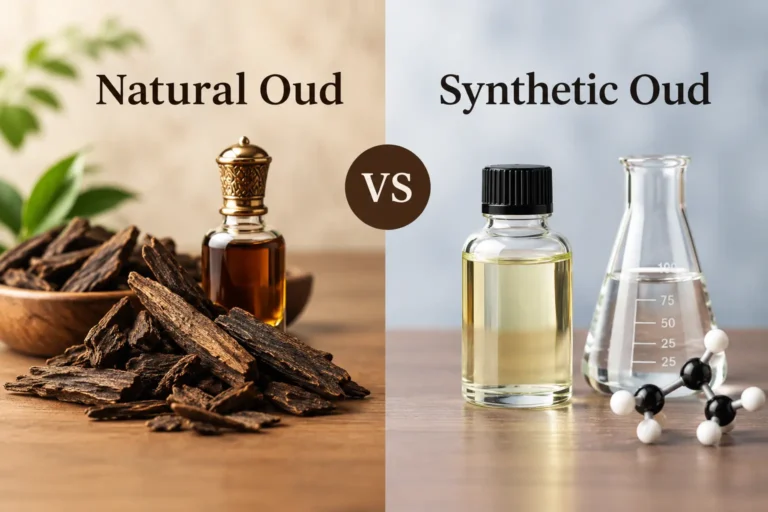
Natural Oud vs Oud Accords in Perfume
Another important point when studying oud perfume notes is the difference between natural oud materials and constructed oud accords.
Natural oud oil is derived from resinous agarwood from certain trees, particularly species within the Aquilaria and related genera.
A perfume may instead use a fragrance accord designed to reproduce some characteristics associated with oud.
This does not automatically tell you whether the perfume smells good or bad. It simply means the fragrance can be constructed using different materials and techniques.
For consumers, checking the fragrance’s official ingredient information and brand description is more useful than assuming that every perfume labeled “oud” contains the same type or amount of natural oud oil.
How Oud Perfume Notes Change Over Time
A simple example can show how a fragrance pyramid works.
Imagine an oud perfume with:
Top: Bergamot, saffron, cardamom
Heart: Rose, jasmine, cinnamon
Base: Oud, amber, sandalwood, musk
Immediately after spraying, you may notice the citrus and spices.
After some time, the floral and spicy heart becomes more noticeable.
Later, the fragrance settles into a deeper combination of oud, amber, sandalwood, and musk.
This gradual transition is known as the dry-down.
A Simple Oud Dry-Down Timeline
0–15 minutes:
Fresh citrus, spices, and aromatic ingredients may dominate.
15–60 minutes:
Floral, spicy, fruity, and woody heart notes become more noticeable.
Several hours later:
Oud, amber, woods, musk, vanilla, and other base materials may dominate.
These timings are only general examples. Skin chemistry, temperature, humidity, application amount, and perfume formulation can significantly affect development.
How to Read Oud Perfume Notes Before Buying
When shopping for an oud fragrance, don’t look only at the word “oud.”
Instead, examine the complete note structure.
1. Check the Top Notes
If you prefer fresh fragrances, look for ingredients such as:
- Bergamot
- Lemon
- Mandarin
- Orange
- Mint
- Aromatic spices
2. Examine the Heart
If you enjoy floral or spicy perfumes, look for:
- Rose
- Jasmine
- Saffron
- Cinnamon
- Cardamom
- Lavender
3. Study the Base
For a deeper fragrance, look for:
- Oud
- Amber
- Sandalwood
- Musk
- Vanilla
- Patchouli
- Cedarwood
Understanding oud perfume notes this way can help you predict the general character of a fragrance before purchasing it.
Oud Perfume Notes for Hot and Cold Weather
Climate can influence how a fragrance feels and projects.
In hot weather, strong fragrances can become more noticeable because heat can increase evaporation and diffusion.
Fresh citrus, aromatic, and lighter woody oud perfume notes may therefore feel more comfortable for daytime wear in warm climates.
For cooler evenings, richer combinations involving oud, amber, vanilla, musk, leather, spices, and woods can create a warmer fragrance experience.
This is especially relevant for people choosing oud perfumes in Kuwait and other Gulf countries, where outdoor temperatures can be very high for much of the year.
Oud Perfume Notes for Different Occasions
Different note combinations can suit different situations.
For the Office
Consider fragrances with:
- Citrus
- Soft woods
- Light spices
- Clean musk
- Moderate oud
A balanced composition may be more suitable than an extremely powerful fragrance.
For Date Night
You might prefer:
- Rose
- Vanilla
- Amber
- Saffron
- Smooth oud
These combinations can create a warmer and more intimate fragrance profile.
For Weddings and Special Events
Traditional Middle Eastern-style compositions often feature rich combinations of:
- Oud
- Rose
- Amber
- Saffron
- Musk
- Sandalwood
The right choice depends on personal preference and how strong you want the fragrance to be.
For Daily Wear
Look for a balanced fragrance containing:
- Fresh opening notes
- Soft floral or aromatic heart notes
- Moderate woods or oud in the base
Why the Same Oud Perfume Smells Different on Different People
Oud perfume notes can smell different from person to person.
Several factors can affect fragrance performance:
- Skin chemistry
- Skin temperature
- Climate
- Humidity
- Application amount
- Moisturization
- Fragrance concentration
- Individual sensitivity to certain aromas
For this reason, a perfume that smells smooth and sweet on one person may seem drier, smokier, or more woody on another.
This is why testing an oud fragrance on your own skin can be more useful than relying entirely on someone else’s description.
Oud Perfume Notes vs Fragrance Notes: What’s the Difference?
The terms can sometimes be confusing.
Fragrance notes refer broadly to the ingredients or scent impressions that make up a perfume.
Oud perfume notes specifically refers to the note structure and scent characteristics of perfumes featuring oud as an important part of the composition.
For example:
Fragrance notes:
Bergamot, rose, vanilla, sandalwood.
Oud perfume notes:
Bergamot, rose, oud, vanilla, sandalwood.
The second composition places oud within the overall fragrance structure.
Frequently Asked Questions About Oud Perfume Notes
What are the three main types of perfume notes?
The three traditional categories are top notes, middle notes, and base notes. Top notes create the opening, middle notes form much of the fragrance’s heart, and base notes provide depth and the longer-lasting foundation.
What are common oud perfume notes?
Common oud perfume notes include oud, rose, saffron, amber, sandalwood, musk, vanilla, patchouli, cedarwood, spices, and citrus ingredients.
Is oud a top, middle, or base note?
Oud is most commonly associated with the base of a perfume because of its deep and persistent character. However, its aromatic facets can influence the fragrance throughout its development.
Why does oud perfume smell different after a few hours?
As the more volatile ingredients fade, different materials become more prominent. This process is called the dry-down. Skin chemistry, temperature, humidity, and formulation also affect how oud perfume notes develop.
What oud perfume notes are best for summer?
Fresh citrus, aromatic, light floral, and moderate woody notes can work well in warm weather. The ideal choice depends on the perfume’s concentration and your personal preference.
What oud perfume notes are best for winter?
Rich woods, amber, vanilla, musk, saffron, spices, and deeper oud compositions can create a warmer fragrance profile that many people enjoy during cooler weather.
How can I choose an oud perfume by its notes?
Start with the ingredients you already enjoy. Choose fresh citrus and aromatic notes for a brighter profile, floral ingredients for a softer character, and woods, amber, musk, or vanilla for a deeper fragrance.
Final Thoughts
Understanding oud perfume notes turns fragrance shopping from guesswork into a more informed process.
Top notes create the initial impression, middle notes develop the heart, and base notes provide the deeper foundation. Oud can interact with every part of this structure, creating fragrances that range from fresh and floral to smoky, woody, sweet, resinous, and luxurious.
The most important thing is to look beyond the word “oud.” Study the complete note pyramid, consider the climate and occasion, and test the fragrance on your own skin whenever possible.
Whether you’re shopping for an oud perfume in Kuwait, exploring Arabic perfumery, or looking for an international fragrance, understanding oud perfume notes can help you make a more informed choice and appreciate how the scent evolves from the first spray to the final dry-down. types of oud