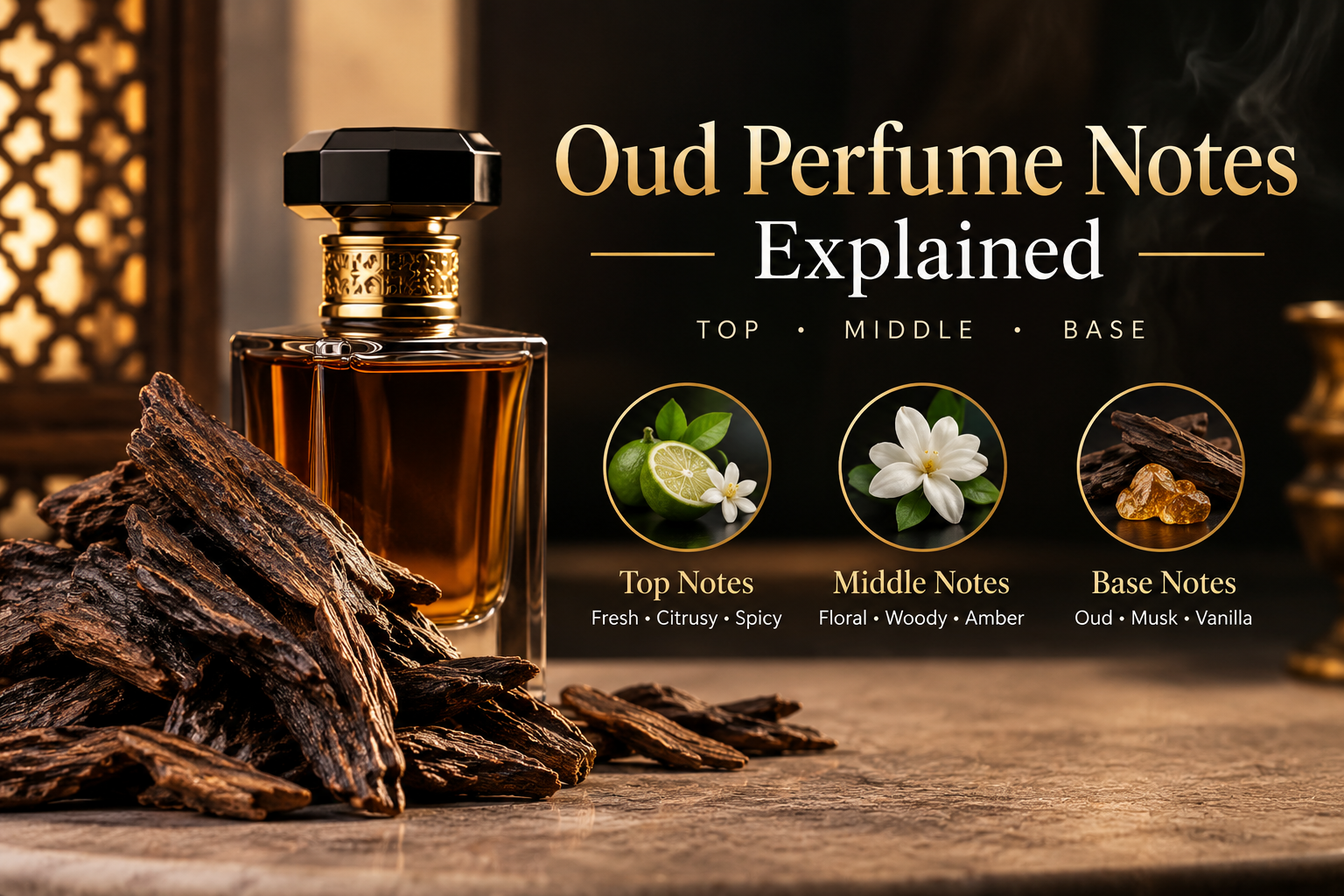
Oud Perfume Notes Explained: Top, Middle, and Base
Have you ever sprayed an oud perfume and noticed that its scent changes after a few minutes? At first, it might smell fresh, citrusy, or slightly spicy. Later, rich woods, roses, or warm spices may emerge. Finally, a deep, smoky, sweet, or resinous aroma can linger on your skin for hours.
This transformation is what makes oud fragrances so fascinating.
Understanding oud perfume notes explained: top, middle, and base notes helps you discover why a fragrance smells different throughout the day, how to choose a scent that matches your personality, and what makes certain oud perfumes feel fresh while others smell dark, warm, and mysterious.
Whether you are buying your first oud fragrance or exploring more sophisticated blends, learning about perfume notes can help you make a smarter choice. In this guide, we will explore each fragrance layer, explain how oud behaves at different stages, and share practical tips for finding an oud perfume you will genuinely enjoy wearing.
What Are Oud Perfume Notes Explained, and Why Do They Matter?
Perfume notes are the individual scents you can detect in a fragrance. They work together to create its overall character, much like musical notes combine to form a melody.
Most traditionally structured perfumes are described using three layers:
- Top notes: The first scents you notice immediately after spraying.
- Middle notes: The heart of the fragrance that develops as the opening fades.
- Base notes: The deeper, longer-lasting scents that give the perfume warmth, richness, and depth.
These layers are often illustrated as a fragrance pyramid. However, perfume does not always develop in a perfectly linear order. Some ingredients appear together, and certain notes may remain noticeable from the first spray until the fragrance fades.
Understanding these layers is particularly useful when shopping for oud perfume because oud can interact beautifully with fresh citrus, delicate florals, warm spices, amber, musk, and other woody materials.
1. Oud Perfume Top Notes: The First Impression
Top notes are the first scents you experience when applying an oud perfume. They create the fragrance’s initial impression and are usually the most noticeable during the first few minutes.
Because many oud fragrances feature deep, intense, woody aromas, perfumers often use brighter ingredients to make the opening feel fresh, inviting, and balanced.
Common Top Notes in Oud Perfumes
- Bergamot: Adds a bright, citrusy freshness that can make rich oud feel lighter.
- Lemon: Provides a clean, sharp, refreshing opening.
- Saffron: Introduces a luxurious, slightly leathery, warm-spicy character.
- Cardamom: Creates a smooth, aromatic spice that works beautifully with woody scents.
- Pink pepper: Adds a lively, peppery sparkle to the fragrance.
Not every oud perfume contains these ingredients. The opening depends on the perfumer’s formula and the fragrance’s intended character.
How Do Oud Perfume Top Notes Smell?
Imagine spraying an oud fragrance that opens with bergamot and cardamom. The first impression may feel bright, crisp, and gently spicy rather than overwhelmingly woody. As those lighter aromas soften, the deeper character of the fragrance becomes more apparent.
This is one reason not to judge an oud perfume immediately after spraying it.
Pro tip: Give your fragrance some time to develop on your skin before deciding whether you like it. A sharp opening can become a smooth, elegant scent as the perfume evolves.
2. Oud Perfume Middle Notes: The Heart of the Fragrance
Middle notes, also called heart notes, emerge as the top notes begin to fade. They help define the fragrance’s personality and connect its bright opening to its deeper base.
In oud perfumes, the heart often determines whether the scent feels floral, spicy, creamy, earthy, smoky, or traditionally oriental.
Popular Middle Notes in Oud Fragrances
Rose
Rose and oud form a celebrated pairing. Rose adds a rich floral elegance that can soften oud’s darker woody character. Depending on the blend, the result may feel romantic, opulent, or deeply traditional.
Saffron and Spices
Saffron, cardamom, and other aromatic spices can create warmth and complexity. They are especially appealing in bold oud fragrances designed for evening wear.
Jasmine and Other Florals
Floral notes can give oud a softer, more luminous character. They are useful when a perfumer wants a fragrance to feel sophisticated without making the woodiness dominate every other element.
Woody and Earthy Accords
Some perfumes emphasize woody, earthy, or leathery impressions in the heart. These accords help create a smooth transition into the fragrance’s deeper base.
Why Are Middle Notes Important in Oud Perfume?
The heart is where an oud perfume often reveals its true identity. Two fragrances may open with almost identical citrus and spices but develop into completely different scents.
One might become a rich rose-and-oud composition, while another develops a dry, smoky, leather-like character.
If you prefer a softer and more elegant fragrance, explore oud blended with rose or jasmine. If you enjoy bold, mysterious scents, look for compositions featuring spices, leather accords, or earthy woods.
Remember that the exact ingredients and their placement vary by perfume. Some materials, including oud itself, may be noticeable in more than one stage.
3. Oud Perfume Base Notes: The Long-Lasting Foundation
Base notes are the deeper aromas that become particularly noticeable as a perfume settles. They provide depth, warmth, and the lasting impression that remains after the brighter opening has faded.
This stage is especially important in oud perfumery because oud is prized for its complex woody, resinous, earthy, smoky, and sometimes animalic character.
However, not all oud smells the same. Its character depends on the materials used, the source of the agarwood, the extraction method when natural oud oil is involved, and the overall perfume formula.
Common Base Notes in Oud Perfume
| Base note | Typical scent character |
|---|---|
| Oud | Woody, resinous, earthy, sometimes smoky or leathery |
| Amber accords | Warm, rich, sweet, balsamic |
| Musk | Soft, clean, powdery, or sensual, depending on the material |
| Sandalwood | Creamy, smooth, woody |
| Patchouli | Earthy, woody, sometimes damp or chocolate-like |
| Vanilla | Sweet, creamy, comforting |
| Benzoin | Sweet, balsamic, resinous |
These materials can make an oud perfume feel smooth and comforting or dark and powerful. Their exact effects depend on how the perfumer combines them.
Why Do Base Notes Often Last Longer?
Many base-note materials have lower volatility than the lighter ingredients commonly used in perfume openings. They evaporate more slowly, so their aromas can remain noticeable for longer.
That is one reason oud fragrances are often associated with impressive longevity. However, a perfume’s staying power depends on its entire formula, not simply the presence of oud.
Concentration, ingredient quality, skin chemistry, application, and environmental conditions can all influence performance.
Pro tip: Test an oud fragrance on your skin and smell it again after several hours. The dry-down may reveal a softer, warmer, or more complex character than you noticed at first.
4. How Top, Middle and Base Notes Work Together
Understanding each layer separately is useful, but the real magic happens when they work together.
Consider a hypothetical oud fragrance built around three stages:
Top Notes: Fresh and Sparkling
Bergamot and cardamom create a bright, aromatic opening that introduces the fragrance without immediately overwhelming the senses.
Middle Notes: Floral and Luxurious
Rose and saffron add a warm, elegant heart, creating a bridge between the fresh opening and the deeper woodiness.
Base Notes: Deep and Sensual
Oud, amber, and sandalwood provide a warm, woody foundation that leaves a rich impression as the fragrance settles.
This combination demonstrates how a perfume can move from freshness to floral warmth and finally to a deep woody finish.
The transition does not always happen in three clearly separated phases. Some fragrances reveal all three layers almost immediately, while others change gradually over several hours.
5. Natural Oud vs. Synthetic Oud: Does It Change the Notes?
Natural oud oil is obtained from resinous agarwood, which develops in certain trees, including species of Aquilaria and related genera. Synthetic or reconstructed oud accords use perfumery materials to create an oud-like impression.
Both approaches can produce sophisticated fragrances, but they do not necessarily smell identical.
Natural oud can display complex variations, including woody, earthy, smoky, leathery, sweet, and animalic facets. Its character varies with the wood’s origin, resin composition, extraction process, and other factors.
Synthetic or reconstructed oud accords allow perfumers to shape a more controlled scent profile. They may emphasize clean woods, smoky notes, leather, sweetness, or other characteristics without relying exclusively on natural oud oil.
A perfume may also combine natural oud with synthetic aroma materials.
It is important to understand that the words natural and synthetic do not automatically tell you whether a fragrance is better, stronger, or longer-lasting. Performance and quality depend on the complete composition.
When evaluating an oud perfume, pay attention to its actual scent development rather than relying solely on the label.
6. How to Choose an Oud Perfume Based on Its Notes
The best oud perfume for you depends on your personal taste, the occasion, and the type of scent you want to experience.
For Everyday Wear
Look for oud fragrances with bergamot, fresh spices, soft woods, or clean musk. These combinations can feel