Oud Oil vs Oud Attar vs Oud Perfume: What’s the Difference?
If you have ever searched for oud oil vs oud attar vs oud perfume, you have probably noticed that these terms are often used as though they mean the same thing. They do not always mean the same thing, and that small difference can matter when you are deciding what to buy.
The confusion becomes even greater because different fragrance sellers use words such as oud oil, oud attar, perfume oil, and oud perfume in slightly different ways. In some cases, oud oil refers to the natural oil distilled from agarwood. In other cases, “oud oil” may be used more loosely for an oil-based fragrance that simply features an oud accord.
So, oud oil vs oud attar vs oud perfume is not simply a choice between three versions of the same product. The biggest differences involve what is actually inside the bottle, how the fragrance is made, how it is applied, and what kind of oud experience you want.
In this guide, we will break down oud oil vs oud attar vs oud perfume in simple terms, compare their ingredients, alcohol content, application, scent, projection, longevity, price, and suitability for different fragrance lovers.
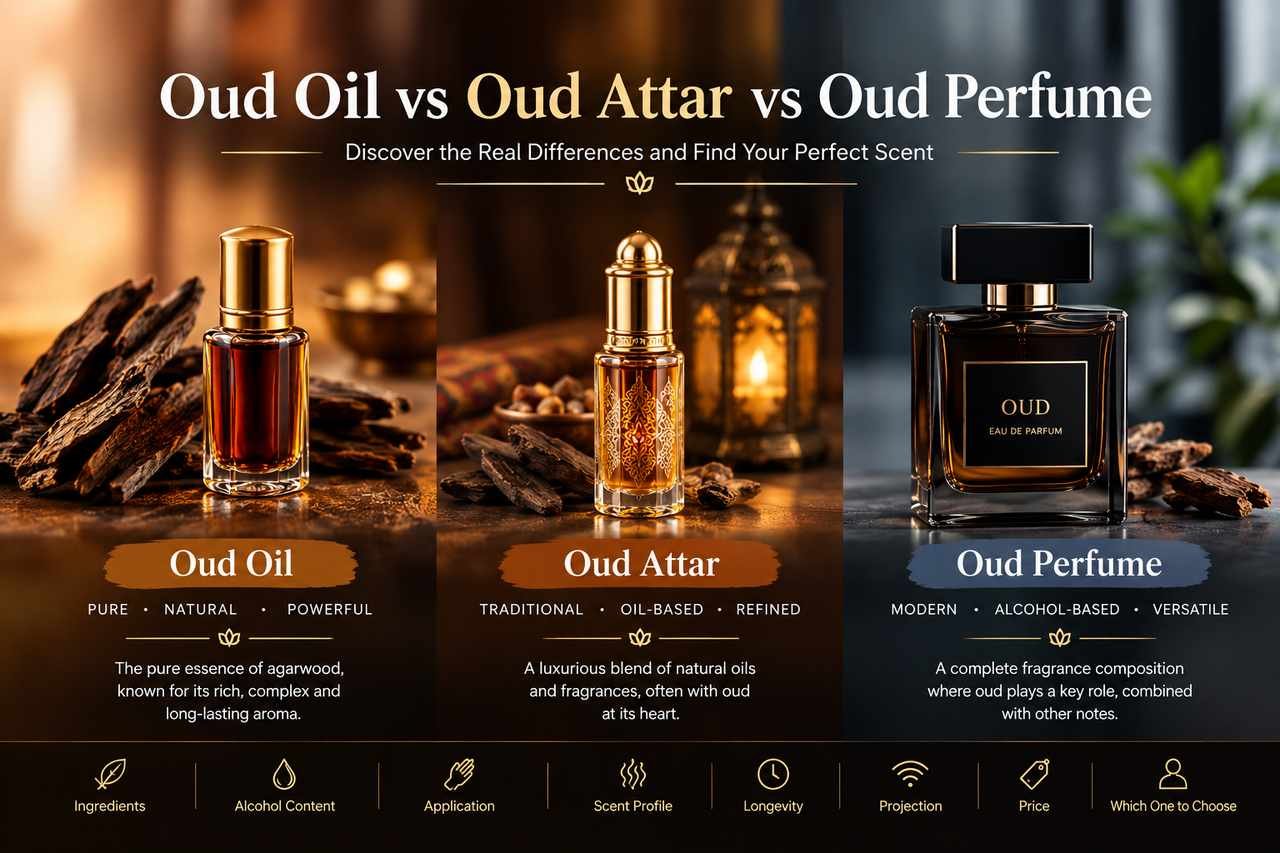
Oud Oil vs Oud Attar vs Oud Perfume at a Glance
Before getting into the details, here is the simplest way to understand the three:
| Feature | Oud Oil | Oud Attar | Oud Perfume |
|---|---|---|---|
| Basic meaning | Oud/agarwood oil, usually distilled from agarwood | Oil-based fragrance format that may contain oud | Perfume composition built around or containing an oud scent |
| Typical base | Oud oil itself or a dilution | Oil-based carrier and fragrance materials | Commonly alcohol + fragrance materials |
| Alcohol | Usually none | Usually none in traditional oil-based attars | Usually present in spray perfumes |
| Oud content | Can be pure natural oud oil | Varies from product to product | Varies widely |
| Application | Dab or small drop | Dab, roll-on, or small amount | Spray |
| Scent experience | Direct and often complex | Blended, traditional, or layered | Structured perfume composition |
| Projection | Usually close to moderate | Usually close to moderate | Often noticeable soon after spraying |
| Bottle size | Usually small | Usually small | Often larger |
| Best suited to | Oud enthusiasts | Oil-fragrance and traditional fragrance lovers | People who prefer spray perfumes |
The table gives a general comparison, but there is an important qualification: labels are not standardized across every seller or market. An “oud attar” is not automatically pure oud, and an “oud perfume” is not automatically made with natural oud oil. Reading the composition or ingredient information is therefore more useful than relying on the product name alone.
What Is Oud Oil?
Oud oil, also called agarwood oil or dahn al oud, is the aromatic oil obtained from resinous agarwood. Agarwood develops in certain Aquilaria trees as the tree responds to infection or injury, producing resin-rich heartwood. That material can then be distilled to produce oud oil.
This is the first major point to understand when comparing oud oil vs oud attar vs oud perfume: oud oil can refer to the fragrance material itself.
Natural oud oil is not a single uniform smell. Its aroma can vary according to the source of the agarwood, the material used for distillation, the distillation process, and other factors. Different oud oils can show woody, resinous, smoky, leathery, sweet, earthy, or even animalic facets.
That complexity is one reason experienced oud users often enjoy sampling oils from different origins. Instead of smelling a complete perfume formula in which oud is surrounded by many other notes, you can experience much more of the character of the oud material itself.
How Is Oud Oil Made?
The process begins with resinous agarwood. The wood is prepared and distilled, commonly through methods such as steam or hydro-distillation, producing an aromatic oil.
The exact production process can have a major influence on the final scent. Two oils made from different agarwood materials can smell remarkably different even though both are sold as oud oil.
This is also why simply seeing the words “pure oud oil” on a bottle should not be the end of your research. If authenticity matters to you, look for clear information about the material, origin, extraction, and composition.
Is All Oud Oil Pure?
No.
This is one of the most important things to understand when comparing oud oil vs oud attar vs oud perfume. The term “oud oil” does not automatically mean that a product contains 100% pure, natural agarwood oil.
A seller may use “oud oil” to describe genuine natural agarwood oil, diluted oud oil, or even an oil-based fragrance created to reproduce the smell of oud. This distinction is especially important when researching oud oil vs oud attar vs oud perfume, because these products can look similar while containing very different ingredients.
Natural oud oil is produced from agarwood, while synthetic or fragrance oils can be formulated to imitate the characteristic oud aroma. Neither label alone tells you exactly what is inside the bottle.
Therefore, always check the product description, ingredients, concentration, and claims before buying. If you’re comparing oud oil vs oud attar vs oud perfume, don’t assume that every product labeled “oud” contains 100% natural agarwood oil.
What Is Oud Attar?
Oud attar is where the terminology becomes confusing.
The word attar generally refers to an oil-based fragrance format rather than a guarantee of one particular fragrance ingredient. In other words, “attar” tells you something about the form of the fragrance, but it does not automatically tell you how much natural oud is inside it.
For example, an oil-based fragrance can be made around rose, sandalwood, musk, oud, or a combination of different materials. An oud attar may therefore contain oud as its main character, but it may also contain other fragrance materials.
This creates an important relationship between oud oil vs oud attar: natural oud oil can itself be used as an oil fragrance, while an oud attar can be a more complex oil-based blend.
Is Oud Attar the Same as Oud Oil?
No
This is probably the most important question in the entire oud oil vs oud attar vs oud perfume comparison.
If a bottle contains undiluted natural oud oil and is sold as an oil fragrance, some sellers may call it oud attar. But another product labeled “oud attar” could contain oud together with carrier oils and other fragrance materials.
That means two products called “oud attar” can smell very different.
The safest approach is to look beyond the word attar. Check whether the product is described as:
- Pure oud oil
- Oud oil diluted in a carrier
- An oud-based attar blend
- A perfume oil containing an oud accord
- A blend of oud with other natural or synthetic fragrance materials
The label matters more than the marketing name.
Oud Oil vs Oud Attar: Key Differences
The easiest way to compare oud oil vs oud attar is to remember that one term can describe a material, while the other commonly describes a fragrance format.
Composition
Pure oud oil can be the distilled aromatic material obtained from agarwood.
Oud attar, on the other hand, may be a complete oil-based fragrance containing oud plus other materials.
Scent
Pure oud oil can place the character of agarwood at the center of the experience.
An oud attar can be smoother or more layered because it may combine oud with woods, florals, spices, musk, amber, or other fragrance materials.
Application
Both are generally applied by dabbing a small amount onto the skin rather than spraying a large cloud of fragrance.
Alcohol
Traditional oil-based attars are generally alcohol-free, although exact formulations should always be checked on the product label.
Which One Feels More “Oudy”?
There is no universal answer.
A high-quality natural oud oil may give you a much more direct experience of agarwood. But a carefully made oud attar can also contain a substantial amount of oud while using other ingredients to create a particular fragrance profile.
The key is not simply the word attar. It is the actual formulation.
What Is Oud Perfume?
Oud perfume is a broader category.
Instead of being a bottle of oud oil by itself, an oud perfume is generally a complete fragrance composition in which oud is an important part of the scent profile.
Many spray perfumes use alcohol as the carrier. The perfume may contain natural oud oil, synthetic oud materials, or a combination of fragrance ingredients designed to create an oud-like effect.
This distinction is crucial because “oud perfume” does not automatically mean “pure oud oil in a spray bottle.”
A modern perfume might combine an oud-style accord with rose, saffron, amber, vanilla, citrus, leather, woods, or musk. The result can smell very different from smelling a single natural oud oil.
Current fragrance sources similarly emphasize that natural oud and synthetic oud are different materials, and modern perfumery commonly uses synthetic oud-style materials for consistency, scalability, and creative control.
Oud Oil vs Oud Perfume: What’s the Difference?
The biggest difference in oud oil vs oud perfume is the overall fragrance structure.
Oud Oil Is Usually More Direct
When you smell a natural oud oil by itself, there are fewer surrounding notes competing for attention. You are experiencing the character of the distilled oud material more directly.
Oud Perfume Is Usually More Composed
An oud perfume is designed as a complete fragrance. The perfumer can use oud as the heart, base, or supporting element while adding many other notes.
That means an oud perfume can be:
- Sweet and woody
- Smoky and spicy
- Floral and dark
- Fresh and woody
- Warm and amber-like
- Leathery and resinous
The word “oud” alone does not tell you the entire scent profile.
Natural Oud Oil vs Synthetic Oud in Perfume
This is another area where shoppers can easily become confused.
Natural oud oil vs Synthetic Oud, Natural oud oil comes from agarwood and has the complex chemical profile of a natural distilled material. Synthetic oud materials, by contrast, are laboratory-created materials or accords intended to reproduce or suggest aspects of oud’s smell.
Synthetic oud is not automatically “bad quality.” It is simply a different type of perfumery material. Modern fragrance makers may use synthetic materials because they offer consistency, scalability, and the ability to create a particular scent profile without relying entirely on natural agarwood oil.
The important issue for a buyer is transparency. If you specifically want natural oud oil, look for clear information confirming that the product actually contains it.
Oud Oil vs Oud Attar vs Oud Perfume: Longevity
One of the most common questions about Oud Oil vs Oud Attar vs Oud Perfume is which one lasts longer.
There is no universal answer. When comparing Oud Oil vs Oud Attar vs Oud Perfume, longevity depends on several factors, including:
- Formula
- Concentration
- Ingredients
- Skin chemistry
- Climate
- Application amount
- Fragrance quality
- Natural and synthetic materials used
Oil-based fragrances can remain noticeable close to the skin for a long time, while spray perfumes may create more noticeable diffusion immediately after application. Therefore, Oud Oil vs Oud Attar vs Oud Perfume can perform differently depending on how and where they are applied.
So, it is better not to assume that oud oil always lasts longer than oud perfume or that oud attar always lasts longer than both. The actual performance of each fragrance depends on its formulation, concentration, ingredients, and your individual skin chemistry.ger than oud perfume or that oud attar always lasts longer than both.
Longevity vs Projection
These two terms are often confused.
Longevity means how long you can continue detecting the fragrance.
Projection means how far the fragrance radiates from the wearer.
A fragrance can last for many hours but remain relatively close to the skin. Another fragrance may project strongly shortly after application but become much quieter later.
Understanding this difference makes the oud oil vs oud attar vs oud perfume comparison much more useful.
Oud Oil vs Oud Attar vs Oud Perfume: Application
How to Apply Oud Oil
Oud oil is usually applied in very small quantities. A tiny amount on pulse points such as the wrists or neck can be enough because concentrated oils can be potent.
How to Apply Oud Attar
Oud attar is generally dabbed onto pulse points. Roll-on bottles are also common for oil-based fragrances.
Because attars vary considerably in composition, the amount needed depends on the particular product.
How to Apply Oud Perfume
Spray perfumes are normally applied with one or more sprays to the skin, and some people also apply fragrance to clothing when the product directions allow it.
The application style is therefore one of the easiest practical differences between oud oil vs oud attar vs oud perfume.
Oud Oil vs Oud Attar vs Oud Perfume: Price
Price can vary dramatically in all three categories.
Natural oud oil can be expensive because high-quality agarwood is a limited and valuable fragrance material, and producing the oil requires suitable raw material and distillation.
However, price alone does not prove authenticity.
An expensive bottle can still contain a blend, while a reasonably priced perfume can use a perfectly legitimate synthetic oud accord.
When comparing prices, ask:
- What exactly is inside the bottle?
- How much product are you getting?
- Is the oud natural, synthetic, or a mixture?
- Is it pure oud oil or a finished fragrance?
- Does the seller provide meaningful information about the composition?
That approach is much more reliable than judging a product by price alone.
How to Choose Between Oud Oil, Oud Attar, and Oud Perfume
There is no single option that is right for everyone. Your choice depends on the fragrance experience you want.
Choose Oud Oil If You Want:
- A direct oud experience
- To explore natural agarwood oils
- A concentrated oil format
- To study differences between oud origins and distillations
Choose Oud Attar If You Want:
- An oil-based fragrance
- A traditional fragrance experience
- Oud blended with other fragrance notes
- A dab-on fragrance rather than a spray
Choose Oud Perfume If You Want:
- Convenient spray application
- A complete perfume composition
- Oud combined with other notes
- A modern fragrance style
How to Buy Oud Without Getting Confused
The best advice is simple: read the product description carefully.
Don’t assume that:
Oud = pure natural oud.
Don’t assume that:
Attar = pure oud oil.
And don’t assume that:
Oud perfume = natural oud oil diluted in alcohol.
These assumptions can easily lead to disappointment.
Instead, look for information about the actual composition.
If a seller clearly explains the material, concentration, fragrance format, and ingredients, you can make a much more informed decision.
Common Mistakes When Buying Oud
1. Assuming Every Oud Product Contains Natural Oud
Some perfumes use synthetic oud materials or accords. That does not necessarily make the perfume inferior, but it does mean it is different from a natural oud oil product.
2. Assuming Attar Means Pure Oud
Attar generally describes an oil-based fragrance format. The fragrance can contain oud, but the term itself does not guarantee a specific oud concentration.
3. Comparing Products Only by Bottle Size
A 50 ml bottle of perfume and a 3 ml bottle of concentrated oud oil cannot be compared simply by volume.
4. Assuming Stronger Means Better
A powerful fragrance is not automatically a better fragrance. Some people prefer an intimate scent that stays close to the skin, while others prefer noticeable projection.
5. Buying Without Checking the Composition
The name on the front of the bottle tells only part of the story.
Frequently Asked Questions
Is oud oil the same as oud attar?
Not always. Oud oil can refer to the aromatic oil distilled from agarwood, while attar generally describes an oil-based fragrance format. A pure oud oil can be sold as an attar, but an oud attar can also be a blend containing oud and other materials.
Is oud perfume the same as oud oil?
No. Oud oil can be the natural agarwood-derived material itself, while oud perfume is generally a complete fragrance composition that may contain natural oud, synthetic oud materials, or other fragrance ingredients.
Does oud perfume contain real oud?
Sometimes, but not always. Some oud perfumes use natural oud oil, while others use synthetic oud materials or accords. Check the manufacturer’s ingredient or composition information if natural oud is important to you.
Which lasts longer: oud oil or oud perfume?
There is no universal winner. Longevity depends on the formula, concentration, ingredients, skin chemistry, climate, and application. Oil format alone does not guarantee a particular number of hours.
Is oud attar alcohol-free?
Traditional oil-based attars are generally made without alcohol, but formulations vary. Always check the product information instead of assuming that every product labeled “attar” has exactly the same composition.
Is natural oud better than synthetic oud?
They are different fragrance materials rather than simply two grades of the same product. Natural oud comes from agarwood, while synthetic oud materials are created to reproduce or suggest aspects of oud’s aroma. The better choice depends on whether you want the character of natural agarwood, a particular perfume effect, consistency, or another characteristic.
Final Thoughts on Oud Oil vs Oud Attar vs Oud Perfume
Understanding oud oil vs oud attar vs oud perfume becomes much easier once you stop treating the three terms as interchangeable.
Oud oil can refer to the actual aromatic oil distilled from agarwood. Oud attar generally describes an oil-based fragrance and may contain oud as the main material or as part of a blend. Oud perfume is usually a complete perfume composition in which oud plays an important role, whether the formula uses natural oud, synthetic oud materials, or both.
The most important lesson is to look beyond the word “oud.” Read the product description, check the composition, understand whether the product is a raw material or a finished fragrance, and decide whether you want a direct oud experience or a more elaborate perfume.
Once you understand those differences, comparing oud oil vs oud attar vs oud perfume becomes much less confusing—and choosing the right type of fragrance becomes much easier.
Meta Title
Oud Oil vs Oud Attar vs Oud Perfume: Key Differences
Meta Description
Oud Oil vs Oud Attar vs Oud Perfume explained. Learn the differences in ingredients, scent, longevity, projection, application, price, and how to choose.
Permalink / URL Slug
/oud-oil-vs-oud-attar-vs-oud-perfume/
Primary Focus Keyword
Oud Oil vs Oud Attar vs Oud Perfume
Suggested Secondary Keywords
- oud oil vs oud attar
- oud oil vs oud perfume
- oud attar vs oud perfume
- what is oud oil
- what is oud attar
- what is oud perfume
- pure oud oil vs perfume
- natural oud vs synthetic oud
- oud fragrance oil vs oud oil
- is oud attar the same as oud oil


2 Comments