Why Is Oud So Expensive? The Real Reasons Behind Its High Price
Why is oud so expensive, when it comes from a tree? At first glance, it seems like an ordinary piece of wood should not cost anywhere near as much as a luxury fragrance. But oud is not ordinary wood. The valuable material comes from resin-rich agarwood, which develops inside certain trees of the Aquilaria and related genera after injury, stress, or biological attack. The amount and quality of that resin can vary greatly, which makes high-quality agarwood difficult to obtain.
That is the starting point for understanding why is oud so expensive. The price is connected to biology, time, limited supply, harvesting, processing, distillation, quality, regulation, and demand. And when genuine oud oil is used in a perfume, all of those costs can eventually influence the final price.
In this guide, we’ll follow the entire journey from tree → resin → agarwood → harvesting → distillation → oud oil → perfume so you can understand what you are actually paying for.
Why Is Oud So Expensive? Understanding What Oud Really Is
Oud, also called oudh, is closely associated with the fragrant resinous heartwood known as agarwood. It is produced from certain trees in the Aquilaria and related genera. When suitable resin develops inside the wood, it can be processed into fragrant chips, distilled into oil, or used in perfumes and incense.
A healthy tree does not simply contain a bottle of oud waiting to be extracted. The valuable resinous material develops as part of the tree’s response to injury, stress, and biological processes. That is one reason the supply of high-quality natural oud is inherently limited.
The result can be remarkably complex. Depending on the species, geographic origin, resin characteristics, processing, and other factors, oud can smell woody, smoky, sweet, balsamic, leathery, earthy, or even animalic.
So, why is oud so expensive? The first answer is simple: you are not paying for ordinary wood. You are paying for a rare and valuable resinous material that takes time and specialized work to produce.
Why Is Oud So Expensive?
There is no single reason behind the price of oud. Several factors work together.
The biggest ones are:
- Natural oud is relatively rare.
- Resin formation takes time.
- Not every tree produces valuable agarwood.
- Harvesting and processing can be labor-intensive.
- Oud oil has a very low yield compared with the amount of wood required.
- Quality varies dramatically.
- Origin and species can affect value.
- Legal sourcing and international trade regulations add complexity.
- Traditional and modern demand remains strong.
- Natural oud and synthetic oud have very different production economics.
Understanding these factors makes the high price much easier to explain.
1. Oud Comes From a Rare Resinous Material
One of the biggest misunderstandings about oud is assuming that every Aquilaria tree automatically produces valuable oud.
It doesn’t.
The commercially valuable part is resinous agarwood rather than ordinary, unresinated wood. CITES documentation describes agarwood as a product associated with Aquilaria and notes that its commercial value depends on characteristics including scent, shape, weight, colour, and quality.
This creates a natural supply problem.
You can have many trees growing in suitable regions, but that does not mean you have the same amount of high-quality resinous material available for harvesting.
And even when resin is present, its amount and quality can differ considerably.
That scarcity is one of the foundations of why is oud so expensive.
2. How Does Oud Form Inside the Tree?
This is where oud becomes particularly interesting.
The tree itself is not valuable simply because it belongs to the Aquilaria group. The valuable aromatic material develops when the tree responds to biological stress or injury and produces resin in the affected wood.
Over time, the resin-rich wood can become darker, denser, and much more aromatic than normal wood.
The exact biological process is more complicated than simply saying that “a fungus makes oud.” Different biological and environmental factors can be involved, and modern cultivation also uses artificial inoculation techniques to encourage agarwood formation.
CITES research notes that different inoculation approaches are being studied to improve agarwood production, showing that cultivated production is more complicated than simply planting a tree and waiting for oud to appear.
This is important because oud cannot be produced in exactly the same way as a conventional fragrance ingredient such as a simple synthetic aroma material.
Nature has a major role in the process.
3. Oud Takes Time to Develop
Time is another major part of the price.
Natural agarwood formation is not an instant process. Resin develops over an extended period, and the resulting material can vary according to the tree, location, biological process, and stage of development.
Some commercial sources describe periods of many years or even decades for valuable natural material, although there is no single age that guarantees high-quality oud.
This distinction matters.
A ten-year-old tree is not automatically better than a five-year-old tree, and an older tree does not automatically guarantee superior oud. Quality depends on much more than age alone.
Still, the basic economics are obvious: you cannot suddenly manufacture decades of natural resin formation when demand increases.
That limited time factor helps explain why high-quality natural oud can command such high prices.
4. Not Every Tree Produces the Same Amount of Valuable Oud
Another reason behind the price is variation.
Even when trees are cultivated specifically for agarwood production, the resulting resin can differ from one tree to another.
Some wood may contain a relatively small amount of resin. Other material can be much more heavily resinous.
That means producers have to sort and grade the raw material.
CITES material on agarwood production also highlights substantial variation in the amount of agarwood obtained from trees and the challenge of maximizing high-quality production.
So the market isn’t simply:
1 tree = 1 bottle of oud.
It is more like:
trees → variable resin formation → sorting → grading → processing → different yields → different values.
That variation is a major part of the answer to why is oud so expensive.
5. Harvesting Agarwood Can Be Labor-Intensive
Once valuable resinous material is available, the work doesn’t end.
Agarwood may need to be harvested, transported, cut, sorted, trimmed, prepared, and graded before it can become the material used for incense or oil.
CITES documentation describes initial agarwood extraction in many countries as labor-intensive and notes the involvement of workers in activities such as plantation work and hauling.
The quality of the raw material matters, so experienced producers also need to distinguish between different grades and portions of wood.
This adds another layer of cost before distillation even begins.
6. Producing Oud Oil Requires a Lot of Raw Material
This is perhaps the easiest way to understand the economics.
Oud oil is not simply squeezed out of a piece of wood.
The agarwood must be prepared and processed, and then aromatic compounds are extracted through distillation. The amount of oil obtained can be very small compared with the quantity of wood used.
Reported yields vary significantly depending on the raw material and production method. Industry sources describe examples ranging from very low yields for premium material to higher yields from other grades.
That means you should be careful with claims such as:
“Exactly X kilograms of wood always produce Y millilitres of oil.”
There is no universal number.
The type of wood, resin content, preparation, distillation technique, and equipment can all affect the final yield.
But the basic principle remains the same:
A large amount of valuable raw material can produce a surprisingly small amount of oud oil.
That low-yield relationship is one of the clearest answers to why is oud so expensive.
7. Oud Distillation Takes Skill, Time, and Equipment
Turning agarwood into oud oil is not the same as mixing fragrance ingredients together.
Traditional production can involve preparing or soaking the wood, loading it into a still, distilling it for an extended period, collecting the oil, and then filtering or further processing it.
Different producers use different techniques, and the details can significantly influence the character of the resulting oil.
The distiller must also understand the raw material.
Too little control can waste expensive wood. Different grades may require different treatment. The resulting oil must then be evaluated for its aroma and quality.
This combination of expensive raw material + specialized equipment + time + skilled labor contributes directly to the final cost.
8. Oud Quality Can Vary Enormously
Not all oud is priced equally because not all oud is the same.
Two oils can both be labeled “oud” while having very different:
- Resin concentrations
- Origins
- Species
- Distillation methods
- Aroma profiles
- Purity levels
- Production conditions
- Aging or maturation histories
- Blending practices
CITES notes that agarwood is traded in different qualities and that factors such as scent, shape, weight, and colour influence commercial value.
This is why asking “How much does oud cost?” without specifying the type of oud is almost impossible to answer accurately.
A small amount of exceptionally rare oud oil can have a completely different price from a commercial oud fragrance oil.
9. Where the Oud Comes From Can Affect Its Price
Oud is associated with several regions across South and Southeast Asia.
You may encounter names such as:
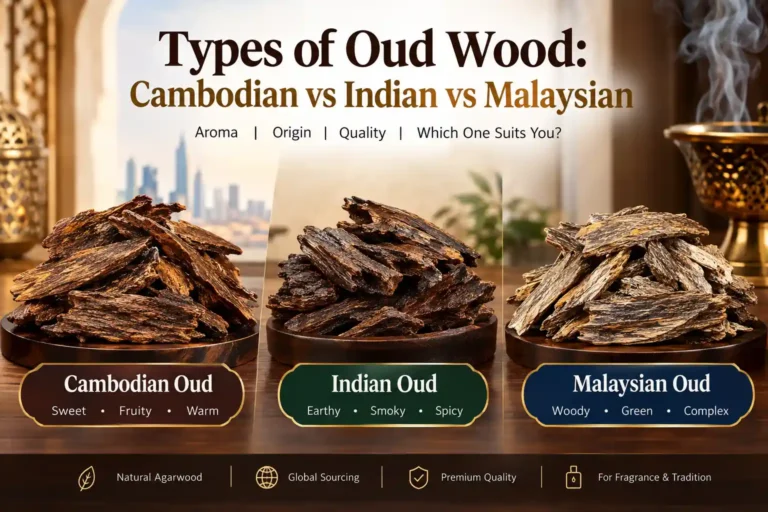
- Hindi oud
- Cambodian oud
- Malaysian oud
- Indonesian oud
- Vietnamese oud
- Thai oud
These names can refer to geographical or commercial categories, but they should not be treated as absolute quality rankings.
Different origins can produce different aromatic characteristics, and the species, growing conditions, resin formation, processing, and distillation method can all influence the result.
CITES documentation specifically notes that agarwood is traded in different qualities and that the value of traded products varies according to their characteristics.
So if one origin costs more than another, the difference may involve scarcity, sourcing conditions, quality, demand, production practices, and market preferences rather than geography alone.
10. Why Is Natural Oud More Expensive Than Synthetic Oud?
This is one of the most important distinctions for fragrance buyers.
Natural oud originates from resinous agarwood and requires biological formation, harvesting, processing, and distillation.
Synthetic oud, by contrast, uses manufactured aroma materials designed to create some of the characteristics associated with oud.
Synthetic materials can be produced much more consistently and at much larger scale than rare natural oud. That makes them far more economical for many commercial perfumes.
This does not mean synthetic automatically equals “bad” or natural automatically equals “better.” They are different materials with different production methods, characteristics, and costs.
Synthetic oud is one reason modern perfumes can offer an “oud” style at prices far below those of some genuine natural oud oils.
11. Why Is Oud Perfume Expensive If It Contains Only a Little Oud?
This is where many buyers misunderstand fragrance pricing.
The price of an oud perfume is not necessarily the same thing as the price of pure oud oil.
A finished perfume can contain:
- Natural oud oil
- Synthetic oud materials
- Other natural ingredients
- Synthetic aroma materials
- Alcohol or another carrier
- Fixatives
- Packaging
- Bottle manufacturing
- Labor
- Distribution
- Marketing
- Brand costs
Therefore, an expensive perfume does not automatically prove that it contains a large amount of natural oud.
Likewise, an affordable perfume does not automatically mean that it is poor quality.
The formula and concentration matter.
A fragrance containing a small amount of natural oud can still be expensive because the natural ingredient itself may have a high cost, while the rest of the formula and the brand’s production costs also contribute to the retail price.
12. Why Is Some Oud Surprisingly Cheap?
This question is just as important as asking why is oud so expensive.
If you find a product advertised as “pure oud” at an unusually low price, there could be several explanations.
It might be:
- A synthetic oud accord
- A fragrance oil inspired by oud
- Diluted natural oud
- A blend of natural and synthetic materials
- Lower-grade agarwood oil
- Cultivated agarwood
- A product with a very small concentration of genuine oud
The word “oud” on a label alone does not tell you exactly what is inside.
That is why buyers should look at the ingredient information and product description instead of judging authenticity purely from the price.
13. Natural Oud vs Synthetic Oud: Why the Price Difference?
| Factor | Natural Oud | Synthetic Oud |
|---|---|---|
| Source | Resinous agarwood | Manufactured aroma materials |
| Formation | Natural biological process | Controlled manufacturing |
| Supply | Limited and variable | Highly scalable |
| Production time | Potentially years or decades for natural resin formation | Much faster |
| Yield | Dependent on resinous wood and distillation | Manufactured directly as aroma materials |
| Consistency | Can vary between batches | Generally more consistent |
| Cost | Can be very high | Usually much lower |
| Use | Oud oils, niche/luxury perfumery, traditional fragrance | Mass-market and luxury fragrances |
| Aroma | Complex and highly variable | Designed to reproduce selected oud characteristics |
The table explains the economics without assuming that one material is universally superior.
14. CITES and Legal Trade Also Matter
There is another part of why is oud so expensive that buyers often overlook: regulation.
Agarwood-producing species are subject to international trade controls under CITES. CITES documentation explains that agarwood is traded internationally in several forms, including resinous wood and chips, distilled oil, and other processed products.
Regulation exists because wild populations and international trade require management.
For legitimate businesses, legal sourcing can involve documentation, permits, traceability, and compliance requirements depending on the species, country, and form of the product.
These requirements can add complexity to the supply chain.
However, regulation should not be confused with the claim that every expensive oud is expensive because of paperwork. Regulation is one factor among many.
15. Sustainability Is Part of Oud’s Modern Story
The history of oud also raises an important environmental question.
Wild agarwood resources have faced significant harvesting pressure, which is one reason international regulation and cultivated production have become important parts of the industry.
Modern cultivation and artificial inoculation can help produce agarwood without relying entirely on naturally formed wild material. CITES research describes ongoing work on inoculation techniques and production methods.
This has changed the oud market.
Cultivated oud can provide additional supply, while wild material can remain considerably more limited.
For buyers, responsible sourcing is therefore worth considering alongside scent and price.
16. Does a Higher Oud Price Always Mean Better Quality?
Not necessarily.
Price can reflect rarity, production costs, origin, brand positioning, packaging, distribution, and demand.
A higher price may indicate a rare or expensive raw material, but price alone cannot prove purity or authenticity.
This is especially important in a market where “oud” can refer to several different types of products.
If you are buying oud oil, look beyond the number on the price tag.
Consider:
- What exactly is being sold?
- Is it natural oud oil?
- Is it diluted?
- Is it blended?
- Where does the material come from?
- What information does the seller provide?
- Is there evidence of responsible sourcing?
Those questions are much more useful than simply asking whether an oud is expensive.
17. Why Is Oud Sometimes Called “Liquid Gold”?
You may hear oud described as “liquid gold” because some high-value oud oils can command extraordinary prices by weight.
The expression is mainly a way of emphasizing rarity and value.
It should not be interpreted literally as meaning that every oud oil is worth more than gold.
There are enormous differences between oud grades, origins, products, and market prices.
So when someone says “liquid gold,” always ask:
What type of oud? What quality? What origin? What concentration?
Without those details, the phrase tells you very little about the actual product.
18. Why Does the Price of Oud Vary So Much?
Here’s the simplest way to understand it:
| Price Factor | Why It Matters |
|---|---|
| Resin formation | Determines whether valuable agarwood exists |
| Resin concentration | More valuable resinous material can increase value |
| Tree and material origin | Different sources have different characteristics and availability |
| Quality | Higher grades can command higher prices |
| Raw material availability | Scarcity increases production difficulty |
| Distillation yield | Low yields mean more raw material is needed |
| Distillation method | Time and technique affect production |
| Labor | Skilled harvesting and distillation add cost |
| Regulation | Legal sourcing and trade compliance add complexity |
| Demand | Strong demand can increase market prices |
| Product format | Raw wood, oil, attar, and perfume have different costs |
| Branding | Luxury packaging and brand positioning can increase retail price |
This is why there is no single universal “oud price.”
19. What Are You Actually Paying For When You Buy Expensive Oud?
Imagine buying a small bottle of natural oud oil.
You are not paying only for the liquid inside the bottle.
Behind that tiny amount may be:
Agarwood tree → resin formation → years of development → harvesting → sorting → transportation → wood preparation → distillation → oil collection → filtering → possible maturation → testing/quality assessment → packaging → distribution.
Every stage can contribute to the final price.
And because the initial raw material is limited and the final oil yield can be small, the cost becomes concentrated into a very small quantity of finished product.
That is the real economic story behind why is oud so expensive.
20. How to Tell What You’re Paying For
If you are considering purchasing oud oil or an oud-based fragrance, don’t rely on the word “pure” alone.
Look for information about:
1. The type of product
Is it oud oil, oud attar, oud perfume, or fragrance oil?
2. The ingredients
Does the seller explain whether natural oud, synthetic materials, or both are used?
3. The origin
Is the source or geographical origin disclosed?
4. The concentration
Is the product pure, diluted, or blended?
5. The sourcing
Does the seller provide meaningful information about legal and responsible sourcing?
6. The price
Does the price make sense for the type and concentration of product being sold?
A very low price doesn’t automatically prove that a product is fake. But it should encourage you to investigate what you are actually buying.
Why Is Pure Oud Oil So Expensive?
Pure natural oud oil can be expensive because it combines several difficult factors at once: valuable resinous raw material, variable resin formation, low extraction yields, specialized distillation, skilled labor, limited supply, and strong demand.
The most important point is that not all products labeled “oud oil” have the same composition or production history.
One bottle may contain a highly concentrated natural oud distillate, while another may be a diluted or blended oil designed around an oud aroma.
That difference can explain a huge price gap.
Is Expensive Oud Worth the Price?
There is no universal answer because value depends on what you are looking for.
If your goal is to experience a particular natural oud profile, you may care about origin, raw material, distillation, purity, and sourcing.
If your goal is simply to enjoy an oud-style fragrance, a synthetic or blended perfume may provide that experience at a much lower cost.
The important thing is understanding the product before paying for it.
Expensive does not automatically mean pure, and inexpensive does not automatically mean fake.
Frequently Asked Questions
Why is oud so expensive?
Oud is expensive because high-quality agarwood is difficult to obtain, resin formation takes time, valuable material can be scarce, extraction yields can be low, and harvesting and distillation require specialized work. Regulation and market demand can also influence the final price.
Is oud more expensive than gold?
Some exceptionally rare oud materials can command prices above gold by weight, but this is not true for every type of oud. Oud prices vary enormously according to quality, origin, product type, and market.
Why is pure oud oil so expensive?
Pure natural oud oil can require substantial amounts of resinous agarwood and specialized distillation, while the final oil yield can be very small. This makes the raw-material cost per millilitre potentially high.
Why is agarwood so expensive?
Agarwood is valuable because high-quality resinous material is relatively scarce and can require significant time, labor, sorting, processing, and legal sourcing before reaching the market.
Is cheap oud fake?
Not necessarily. Cheap oud may be synthetic, diluted, blended, cultivated, or simply a lower-grade product. The price alone cannot establish authenticity.
Does oud perfume contain real oud?
Sometimes, but not always. An oud perfume may use natural oud oil, synthetic oud materials, or a combination of both. The ingredient list and manufacturer’s description are more useful than the perfume’s name alone.
Is synthetic oud cheaper than natural oud?
Generally, yes, because synthetic aroma materials can be produced at much larger scale and with greater consistency than naturally formed resinous agarwood.
Which oud is the most expensive?
There is no single permanent answer. Prices vary according to origin, quality, resin concentration, rarity, production method, age or maturation, and market conditions.
Does older oud always smell better?
No. Age can be relevant to the development and value of some oud materials and oils, but older does not automatically mean better. Aroma quality depends on many factors.
Final Answer: Why Is Oud So Expensive?
So, why is oud so expensive?
The answer begins with the tree but ends with economics.
Valuable oud comes from resinous agarwood, not ordinary wood. Resin formation is variable and can take considerable time. Valuable material must then be harvested, selected, processed, and distilled, often producing only a relatively small amount of oil from the original raw material. Quality, origin, sourcing, regulation, craftsmanship, and demand can all add to the final cost.
There is also an important distinction between natural oud and synthetic oud. A fragrance can smell oud-like without containing large quantities of natural oud oil, which is one reason some oud perfumes are relatively affordable while genuine natural oud oils can be extremely expensive.
Ultimately, the price of oud is not determined by one magical ingredient or simply by luxury branding.
It is the result of a long chain:
Rare resin + time + limited supply + labor + low and variable yield + distillation + quality + sourcing + regulation + demand = oud’s high potential value.
And that is the real story behind why is oud so expensive.