Types of Oud Wood: Cambodian vs Indian vs Malaysian — Why Origin Matters
What if two pieces of oud wood looked almost identical but smelled completely different when placed over gentle heat?
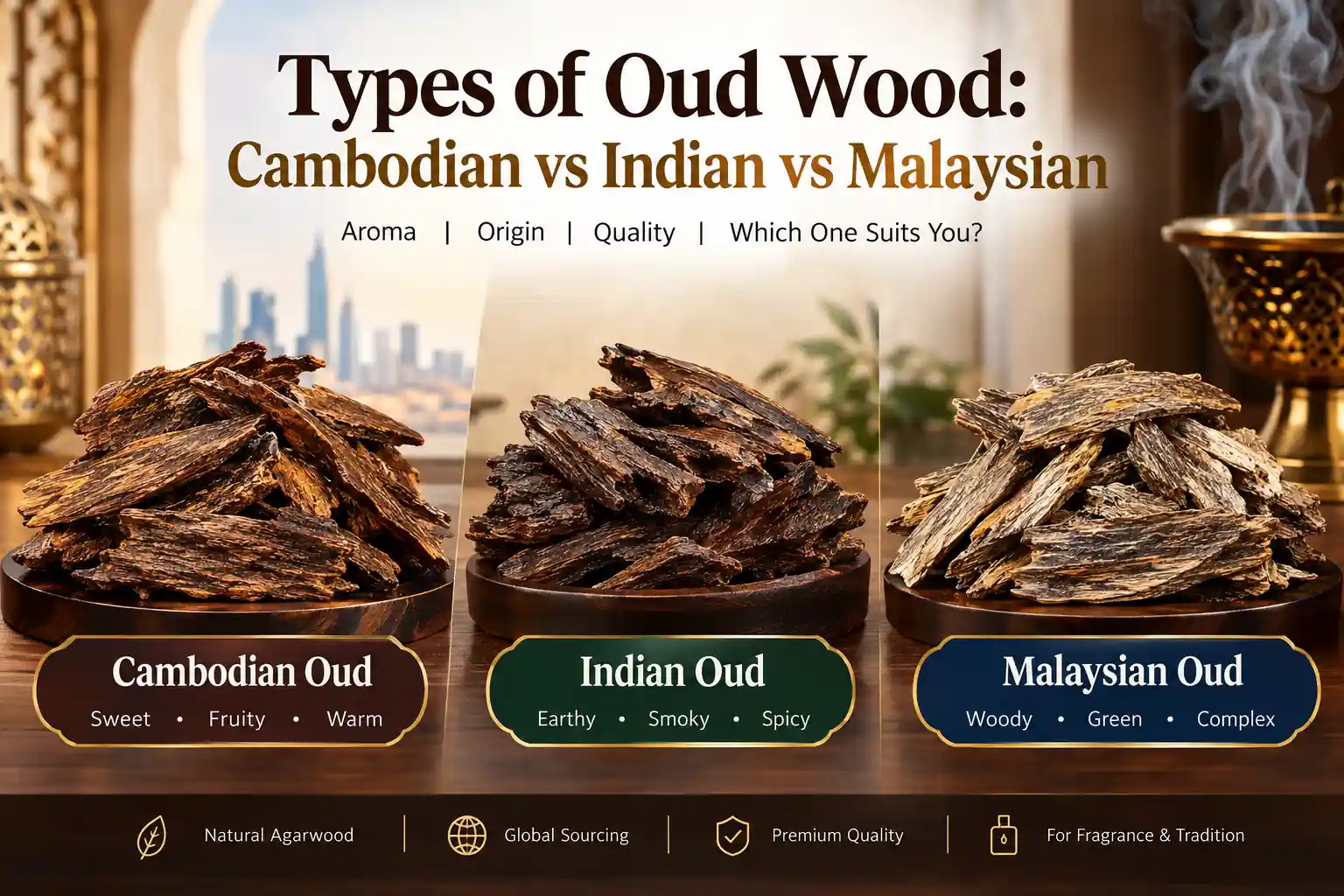
That is the fascinating world of Types of Oud Wood: Cambodian vs Indian vs Malaysian. Oud is not simply “wood with a strong smell.” Its aroma can change dramatically depending on the tree species, geography, resin development, harvesting method, processing, and distillation technique.
For oud lovers in Kuwait and across the Gulf, this difference matters. Oud wood is used for bukhoor, mabkhara rituals, personal fragrance, majlis gatherings, weddings, and religious or cultural occasions. International fragrance enthusiasts are also increasingly interested in authentic agarwood and natural oud oil.
But which origin produces the right scent for you?
In this guide, we will compare types of oud; Cambodian oud, Indian oud, and Malaysian oud by aroma, appearance, resin content, burning characteristics, extraction potential, quality grades, sourcing, and suitability for Gulf-style fragrance.
What Is Oud Wood?
Before comparing the different origins and types of oud wood, it helps to understand what oud actually is. Learning about the Types of Oud Wood begins with understanding its natural source and how its rich fragrance develops.
Oud comes from agarwood, a fragrant, resinous material that forms inside certain trees, particularly those belonging to the Aquilaria genus and related genera. The different Types of Oud Wood vary in aroma, resin content, and scent characteristics depending on their origin and processing.
Healthy agarwood trees do not naturally contain large quantities of the dark, aromatic resin that oud is famous for. This resin develops when the tree experiences certain biological stresses and produces defensive compounds.
The resin-rich material can eventually be harvested and processed into:
- Oud wood chips
- Oud powder
- Dahn al oud
- Oud oil
- Perfume ingredients
- Incense and traditional fragrance products
The darker appearance of a piece of wood can sometimes indicate substantial resin, but color alone does not prove quality or authenticity. This is an important point to remember when exploring the Types of Oud Wood available in the market.
That is one of the first things an experienced oud buyer learns.
Types of Oud Wood: Cambodian vs Indian vs Malaysian
The three origins discussed here are often associated with noticeably different fragrance profiles.
However, there is an important point: origin does not automatically determine quality.
A high-quality Cambodian piece can be extraordinary, while a poor-quality Cambodian piece can disappoint. The same applies to Indian and Malaysian oud.
Quality depends on several factors, including:
- Resin concentration
- Tree species
- Age and development of the resin
- Wild or cultivated origin
- Harvesting practices
- Processing
- Storage
- Distillation technique
- Blending or treatment
- Authenticity
So when comparing Types of Oud Wood: Cambodian vs Indian vs Malaysian, think of geographical origin as one important factor—not the entire quality equation.
Cambodian Oud: Sweet, Rich and Highly Recognizable
Cambodian oud has developed a strong reputation among oud enthusiasts because of its distinctive fragrance character.
Cambodian agarwood is often associated with a sweet, warm, fruity, honeyed, woody, and sometimes slightly smoky aroma.
Depending on the material and processing, Cambodian oud can move from soft and sweet to deep, dark, and powerful.
Cambodian Oud Aroma Profile
You may notice:
- Sweet woody notes
- Fruity nuances
- Honey-like warmth
- Soft resinous character
- Earthy undertones
- Smoky nuances when burned
This combination makes Cambodian oud particularly interesting for people who want an oud that feels rich without being overwhelmingly medicinal.
Cambodian Oud for Burning
When Cambodian oud chips are heated gently on charcoal or another suitable incense burner, resin-rich pieces can produce a dense and luxurious aroma.
In Kuwait and other Gulf markets, Cambodian oud may appeal to people looking for a sweet and welcoming majlis fragrance.
But remember: not every Cambodian chip has the same performance.
A resin-rich piece can smell dramatically different from low-resin wood marketed simply as “Cambodian oud.”
Indian Oud: Deep, Earthy and Traditional
Indian oud has a long association with traditional agarwood culture and the broader South Asian fragrance tradition.
Indian agarwood is often associated with deep, earthy, woody, smoky, spicy, leathery, and sometimes medicinal aromas.
For some oud enthusiasts, this is exactly what makes Indian oud special.
It can feel darker and more traditional than sweeter styles.
Indian Oud Aroma Profile
Depending on the source and distillation, Indian oud may display:
- Earthy wood
- Smoky facets
- Leather-like tones
- Spicy nuances
- Resinous depth
- Medicinal or camphoraceous impressions
- Dark woody character
The word “medicinal” is not necessarily a negative description. In the oud world, experienced users sometimes appreciate these unusual aromatic facets because they contribute complexity.
Indian Oud Oil
Indian oud is also important in traditional dahn al oud production.
Dahn al oud means oud oil, generally referring to oil distilled from agarwood. The final aroma depends heavily on the raw material and distillation process.
A small amount of high-quality oud oil can have remarkable presence.
Malaysian Oud: Woody, Green and Complex
Malaysian oud occupies another interesting position in the world of agarwood.
The aroma can vary significantly between regions, species, resin development, and distillation methods. Malaysian oud may show woody, green, earthy, spicy, resinous, and sometimes slightly sweet characteristics.
Some Malaysian oud materials are appreciated for their complexity rather than simply being extremely sweet or extremely smoky.
Malaysian Oud Aroma Profile
Commonly encountered characteristics can include:
- Green woody notes
- Earthiness
- Resinous warmth
- Spicy facets
- Forest-like impressions
- Soft sweetness
- Smoky nuances
This makes Malaysian agarwood interesting for people who want a fragrance that feels natural and forest-like.
Types of Oud Wood: Cambodian vs Indian vs Malaysian — Aroma Comparison
The easiest way to understand Types of Oud Wood: Cambodian vs Indian vs Malaysian is to compare their typical aromatic tendencies.
| Origin | Typical Character | Sweetness | Earthiness | Smokiness | Common Appeal |
|---|---|---|---|---|---|
| Cambodian | Sweet, fruity, warm, woody | High | Medium | Medium | People who enjoy rich, sweet oud |
| Indian | Dark, earthy, smoky, spicy | Medium | High | High | Traditional oud enthusiasts |
| Malaysian | Woody, green, resinous, complex | Medium | Medium-High | Medium | People seeking natural complexity |
These are general tendencies, not fixed rules.
A particular piece can smell completely different from another piece from the same country.
That is why experienced oud buyers judge the actual material rather than purchasing based only on a country name.
Oud Wood Grades: A, AA and AAA Explained
You will often see oud sellers using grades such as A, AA, and AAA.
But there is something important buyers should understand:
A, AA, and AAA are not universally standardized international oud certifications.
In many markets, they are commercial grading systems created or used by individual sellers.
One seller’s AAA may not equal another seller’s AAA.
What Usually Influences Oud Grading?
Sellers may consider:
- Resin density
- Aroma intensity
- Burning performance
- Oil content
- Appearance
- Wood density
- Cleanliness
- Age
- Origin
- Rarity
However, these criteria can vary considerably.
What About Very Dark Oud?
Dark wood can contain a high amount of resin, but darkness by itself does not guarantee superior quality.
A buyer should evaluate:
- Aroma before heating
- Aroma after gentle heating
- Smoke quality
- Resin behavior
- Longevity
- Authenticity
- Source information
This is particularly important when buying expensive natural oud.
Wild Oud vs Cultivated Agarwood
Another major factor in Types of Oud Wood: Cambodian vs Indian vs Malaysian is whether the agarwood is wild or cultivated.
Wild Oud
Wild agarwood comes from naturally occurring trees and historically has been associated with rarity and exceptional fragrance complexity.
However, uncontrolled harvesting has raised serious conservation concerns.
Cultivated Agarwood
Cultivated agarwood comes from managed plantations.
Producers can stimulate resin formation through controlled methods, allowing agarwood to be produced without depending entirely on naturally occurring wild trees.
Cultivation has become increasingly important because it can help meet demand while supporting more controlled production.
For buyers, cultivated does not automatically mean bad quality.
A well-produced cultivated material can still produce excellent oud wood and oud oil.
How Oud Wood Becomes Oud Oil
Have you ever wondered how a solid piece of agarwood becomes liquid oud oil?
The answer is distillation.
Different producers use different techniques, but traditional oud oil production commonly involves processing agarwood and extracting aromatic compounds through distillation.
The process may involve:
- Selecting agarwood
- Cleaning and preparing the wood
- Cutting or breaking it into smaller pieces
- Soaking or fermenting the material in some production methods
- Distilling the prepared material
- Collecting the aromatic oil
- Aging or resting the oil in some traditions
The exact process can differ considerably between producers.
This is one reason two oils made from the same general region can smell completely different.
Kuwait Oud Culture: Why Origin Matters in the Gulf
For anyone researching Types of Oud Wood: Cambodian vs Indian vs Malaysian, Kuwait deserves special attention.
Oud is deeply connected with fragrance culture across Kuwait and the wider Gulf region.
Walk into a traditional fragrance shop in Kuwait and you may encounter oud chips, oud oils, bukhoor, perfumes, mukhallat blends, and other fragrance products.
Oud is commonly associated with:
- Majlis hospitality
- Weddings
- Family gatherings
- Religious occasions
- Special celebrations
- Personal fragrance
- Traditional Gulf hospitality
A piece of oud placed into a mabkhara can scent an entire room.
That is why Gulf buyers often judge oud differently from someone purchasing an oud perfume simply for everyday wear.
For a Kuwaiti customer, smoke performance, room-filling power, sweetness, depth, and longevity can all be important.
[Internal link: Complete Guide to Oud for Beginners]
How to Identify Authentic Oud Wood
Buying natural oud can be confusing, especially online.
There is no single home test that can prove every piece of wood is authentic.
However, you can reduce the risk of buying poor-quality or misleadingly marketed material.
1. Ask About the Botanical Source
A reputable seller should be able to provide useful information about the agarwood’s source.
2. Ask Whether It Is Wild or Cultivated
This does not determine quality by itself, but it provides important context.
3. Examine the Wood
Look for natural variation rather than perfectly uniform pieces.
4. Smell It Before Burning
High-quality aromatic wood should have a recognizable fragrance even before heating.
5. Test a Small Piece
If possible, gently heat a small sample instead of purchasing a large quantity immediately.
6. Check Seller Transparency
Look for:
- Origin information
- Product descriptions
- Botanical information
- Sustainable sourcing statements
- Laboratory information where relevant
- Clear return policies
[External authority: CITES — agarwood and international wildlife-trade regulations]
Which Oud Wood Is Best for Burning?
There is no universal answer to which origin is “best.”
Instead, ask what kind of experience you want.
Choose Cambodian Oud If You Prefer:
- Sweetness
- Fruity warmth
- Rich woody aromas
- Comfortable room fragrance
- A softer introduction to oud
Consider Indian Oud If You Prefer:
- Darker aromas
- Earthiness
- Smoke
- Leather-like character
- Traditional fragrance profiles
Consider Malaysian Oud If You Prefer:
- Green woody notes
- Forest-like impressions
- Resinous complexity
- Balanced earthy character
- Less predictable aromatic development
This is one reason Types of Oud Wood: Cambodian vs Indian vs Malaysian remains such an interesting comparison.
The “best” oud is ultimately connected to your personal fragrance preference, intended use, and budget.
Oud Wood for Kuwait: What Gulf Buyers Should Consider
If you’re buying oud in Kuwait, don’t purchase solely because a seller writes “AAA Cambodian” or “premium Malaysian.”
Instead, ask practical questions.
Where was the agarwood sourced?
Is it wild or cultivated?
What species or genus is involved?
How was it processed?
Can I smell a sample?
Is the product pure or blended?
For international buyers, shipping regulations also matter. Agarwood and products derived from protected species can be subject to international trade controls depending on the species, product, and destination.
[External authority: CITES — Convention on International Trade in Endangered Species]
Cambodian vs Indian vs Malaysian Oud Oil
The differences become even more fascinating when the wood is distilled into oil.
Cambodian oud oil may be perceived as sweeter, warmer, and more approachable.
Indian oud oil can develop deeper earthy, smoky, spicy, or leathery characteristics.
Malaysian oud oil can offer woody, green, resinous, and complex facets.
But the distiller is extremely important.
The same raw material can produce different oils depending on:
- Distillation duration
- Water-to-wood ratio
- Fermentation
- Distillation equipment
- Temperature management
- Wood preparation
- Aging
- Fraction collection
So oud wood origin tells only part of the story.
Why Oud Prices Can Be So Different
Natural oud pricing can vary enormously.
A seller may charge a relatively modest amount for ordinary cultivated chips, while rare resin-rich material can command much higher prices.
Price can be influenced by:
- Origin
- Resin concentration
- Rarity
- Wild or cultivated status
- Wood quality
- Aroma
- Supply
- Processing
- Seller reputation
- Certification and documentation
For this reason, it is risky to say that Cambodian oud is always more expensive than Indian oud or Malaysian oud.
The specific piece matters.
When shopping in Kuwait, compare the actual material and aroma, not just the country label.
Best Oud Wood for Different Buyers
| Buyer | Consider |
|---|---|
| Oud beginner | Sweeter, approachable Cambodian-style profiles |
| Traditional oud enthusiast | Darker Indian-style profiles |
| Forest/green fragrance lover | Malaysian-style profiles |
| Majlis fragrance user | Resin-rich chips with strong room projection |
| Oud oil collector | Carefully sourced distilled oils |
| Sustainable buyer | Transparent cultivated agarwood sources |
Again, these are starting points rather than strict rules.
Your own nose should have the final say.
How to Store Oud Wood Properly
Even excellent oud can lose some of its character if stored poorly.
Keep oud wood:
- Away from direct sunlight
- In a dry, stable environment
- Away from strong competing fragrances
- In an appropriate airtight or well-sealed container
- Protected from excessive humidity
Some collectors allow oud to rest and mature under controlled conditions.
The goal is simple: protect the aromatic compounds and prevent contamination from unrelated smells.
[Internal link: How to Store Oud Wood and Oud Oil]
Types of Oud Wood: Cambodian vs Indian vs Malaysian — Final Verdict
The world of Types of Oud Wood: Cambodian vs Indian vs Malaysian is much more complicated than simply declaring one country superior.
Cambodian oud is often associated with sweet, warm, fruity, and rich woody aromas.
Indian oud is commonly appreciated for deep, earthy, smoky, spicy, and traditional characteristics.
Malaysian oud can offer green, woody, resinous, earthy, and complex aromatic profiles.
But origin is only one part of the equation.
The resin content, species, cultivation method, processing, storage, distillation, and seller transparency can dramatically influence the final experience.
For Kuwait and Gulf buyers, the best approach is to sample before committing to expensive oud, ask questions about sourcing, and learn how different grades and origins smell when gently heated.
For international oud enthusiasts, the same principle applies: don’t chase a country label alone. Learn the material.
Ultimately, the most rewarding oud is the one whose aroma matches your taste, occasion, and expectations.
If you’re exploring natural oud for the first time, start with small samples of Cambodian oud, Indian oud, and Malaysian oud, compare them side by side, and keep notes about sweetness, smokiness, earthiness, projection, and after-smell.
That is how you develop an oud nose—and once you do, shopping for agarwood becomes a completely different experience.
Frequently Asked Questions About Oud Wood
What is the difference between Cambodian and Indian oud?
Cambodian oud is commonly associated with sweeter, warmer, fruity, and woody aromas, while Indian oud is often deeper, earthier, smokier, and spicier. However, individual pieces can vary significantly.
Is Cambodian oud better than Indian oud?
There is no universally recognized “best” origin. Cambodian and Indian oud can have very different fragrance profiles, so the better choice depends on your preferred aroma and intended use.
What does Malaysian oud smell like?
Malaysian oud can have woody, green, earthy, resinous, spicy, and forest-like characteristics. Its exact aroma depends on species, region, resin development, processing, and distillation.
What are A, AA and AAA oud grades?
A, AA, and AAA are commonly used commercial grading terms. They are not universal international quality standards, so buyers should not assume that AAA from one seller is equivalent to AAA from another.
Is wild oud better than cultivated oud?
Wild oud is traditionally associated with rarity, but cultivated agarwood can also produce high-quality fragrant wood and oud oil. Sustainability and responsible sourcing are important considerations.
Which oud is best for burning in a mabkhara?
The answer depends on your preferred aroma. Sweet Cambodian-style profiles may appeal to people who enjoy warm fragrances, Indian-style oud can suit darker smoky preferences, while Malaysian material can offer green and woody complexity.
How can I tell if oud wood is authentic?
No single visual or home test proves authenticity. Look for transparent sourcing information, botanical details, seller reputation, and, where available, relevant documentation or laboratory testing. Sampling the aroma is also important. the different types of oud

One Comment