Natural Oud vs Synthetic Oud: What’s the Real Difference?
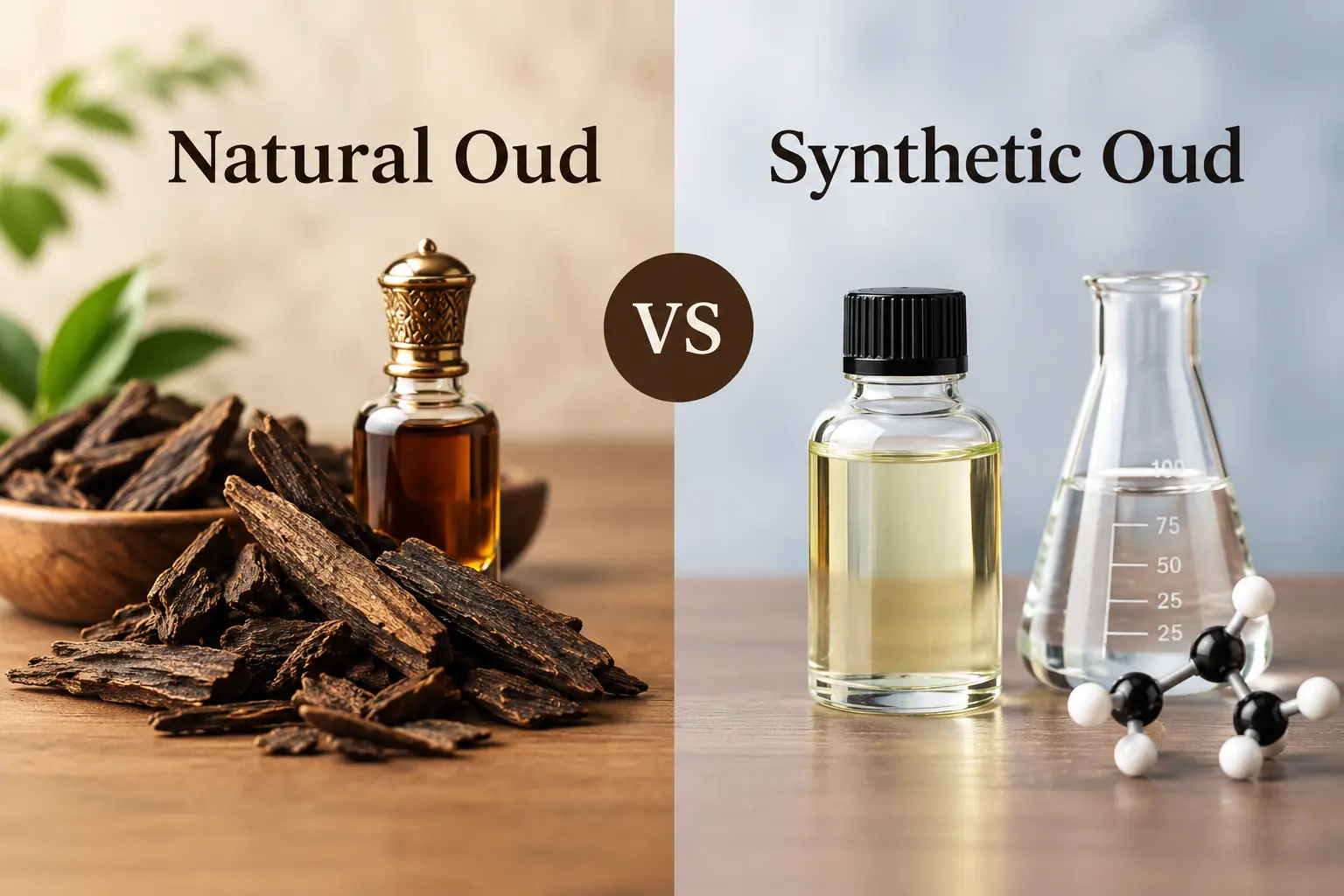
Natural Oud vs Synthetic Oud — few debates in fragrance carry this much mystery and cultural weight! One moment oud smells dark and smoky; the next, warm, woody, sweet, leathery, or startlingly earthy. That shape-shifting quality is exactly why oud has become one of the most prized — and most misunderstood — materials in perfumery.
Here’s where it gets confusing: Natural Oud vs Synthetic Oud are not the same thing, and a bottle simply labeled “oud” won’t tell you which one you’re actually smelling! Is natural oud always better? Does synthetic oud mean the fragrance is fake? And why can two perfumes, both proudly called “oud,” smell completely different from each other?
When exploring Natural Oud vs Synthetic Oud, it helps to first understand where natural oud actually comes from. Natural oud is produced from agarwood—the dark, resin-infused heartwood found in trees of the Aquilaria genus, as well as some related genera such as Gyrinops. The trees develop this aromatic resin as a natural defense response when they are wounded or affected by certain microorganisms. Healthy, undamaged trees generally do not produce the same resin-rich material, which is one reason high-quality agarwood is so scarce and highly prized.
The resin-rich wood is traditionally processed through water or steam distillation to produce oud oil, commonly known in the trade as dahn al oud. Modern extraction techniques may also be used in some applications. Unlike a single synthetic aroma material, natural oud oil contains a complex mixture of aromatic compounds, and its character can vary considerably depending on the species, geographic origin, growing conditions, age of the resin, and distillation method. These differences become especially important when examining Natural Oud vs Synthetic Oud in terms of scent and composition.
This natural variation is one of the biggest points to understand when comparing Natural Oud vs Synthetic Oud. Cambodian oud, for example, may lean sweeter and more balsamic, while Indian or Assam oud is often described as deeper, darker, and more animalic. Malaysian and Indonesian oud can show greener, woody, or medicinal facets. These characteristics are not fixed rules—individual batches can differ significantly even within the same region. That individuality is precisely why oud collectors pay close attention to origin, harvest, and distillation, much like whisky enthusiasts consider the distillery and cask. Understanding this variation is essential to appreciating Natural Oud vs Synthetic Oud and why each can offer a very different fragrance experience
How Natural Oud Is Made
When comparing Natural Oud vs Synthetic Oud, the journey from tree to perfume bottle reveals one of the biggest differences between the two. Producing natural oud is far more involved than simply cutting wood and pressing out oil. Resinous agarwood first has to be identified and carefully harvested—often the hardest part, since resin does not form evenly or predictably.
The wood may then be soaked, sometimes for weeks, before distillation begins. Soaking time, water quality, still material, and distillation length can all influence the final oil. This is why, when exploring Natural Oud vs Synthetic Oud, two producers working with agarwood from the same forest can still produce noticeably different natural oud oils, each with its own character and complexity.
What Is Synthetic Oud?
When exploring Natural Oud vs. Synthetic Oud, it’s important to understand that synthetic oud isn’t simply “fake oud in a bottle.” Instead, synthetic oud is typically an accord—a carefully constructed blend of aroma materials that a perfumer uses to recreate or interpret oud’s characteristic woody, smoky, leathery, or resinous impression without relying entirely on agarwood. This distinction is at the heart of Natural Oud vs. Synthetic Oud and explains why the two can smell remarkably different.
Common building blocks can include woody-amber materials such as Iso E Super or Cashmeran, smoky facets, and leathery or resinous materials. There is no single fixed formula for synthetic oud. Different perfumers and fragrance houses can create very different interpretations, which is why one synthetic oud perfume may smell clean and modern while another can feel dark, smoky, rich, or animalic. In the broader discussion of Natural Oud vs. Synthetic Oud, this flexibility is one of synthetic oud’s defining characteristics.
That flexibility gives perfumers something natural oud cannot provide in quite the same way: precise control. A synthetic oud formula can be adjusted for intensity, projection, longevity, and how it interacts with other notes in a composition. It can also be reproduced consistently from one production batch to another. This level of control is a major reason synthetic oud has become an important part of modern perfumery—and a key consideration when understanding Natural Oud vs. Synthetic Oud.
Natural Oud vs Synthetic Oud: The Real Differences
When comparing Natural Oud vs Synthetic Oud, the biggest differences come down to where they come from, how they are made, how they smell, and how consistently they perform. Here is a closer look at each factor.
Origin. In Natural Oud vs Synthetic Oud, origin is the clearest distinction. Natural oud begins with resinous agarwood, while synthetic oud begins with a perfumer’s formula, built from manufactured aroma materials designed to create an oud-like effect.
Composition. Natural oud’s remarkable complexity comes from nature, with numerous aromatic compounds interacting in ways that can vary from one oil to another. A synthetic oud accord uses a deliberately selected combination of fragrance materials, which can make its development cleaner, more controlled, and predictable. This difference in composition is one of the defining features of Natural Oud vs Synthetic Oud.
Scent Profile. Natural oud has no single smell! It can range from smoky and woody to sweet, medicinal, leathery, earthy, or animalic, depending on its origin and processing. Synthetic oud, by contrast, can be designed around a specific effect—a clean and modern interpretation or something darker, smokier, and heavier. Neither automatically represents the “true” oud smell because natural oud itself can vary enormously.
Evolution on Skin. Natural oud can unfold in stages as different aromatic compounds evaporate and interact with the skin over time. A skillfully designed synthetic accord can also develop beautifully, but a simpler formula may remain more consistent from the opening to the dry-down. This difference in development is another important part of Natural Oud vs Synthetic Oud.
Consistency. This is where synthetic oud offers a major practical advantage. Agarwood is a biological material, so different harvests can vary considerably. A carefully formulated synthetic accord, however, can be reproduced with a high degree of consistency from one production batch to another. For commercial perfumery, that predictability can be extremely valuable.
Price. High-quality natural oud oil can command very high prices because valuable agarwood is scarce and can require considerable effort to source, process, and distill. Synthetic oud accords generally cost much less to produce at scale. However, price alone does not prove whether a fragrance contains natural or synthetic oud. An affordable perfume may contain a small amount of real oud, while an expensive fragrance may rely entirely on synthetic materials.
Sustainability. Aquilaria species and their products are subject to international trade controls under CITES because of conservation concerns. Cultivated agarwood can provide an alternative to wild harvesting, and resin produced from a cultivated, inoculated tree is still natural agarwood. Synthetic oud avoids the need for agarwood in the fragrance itself, but “synthetic” does not automatically mean “more sustainable”; its environmental impact also depends on how its individual aroma materials are manufactured.
Availability. Natural oud is limited by the availability and quality of suitable agarwood, while synthetic oud materials can be produced at the scale required by a fragrance house. When considering Natural Oud vs Synthetic Oud, this difference in availability helps explain why synthetic interpretations are so common in modern commercial perfumery.
Sometimes — and sometimes not! An experienced nose might pick up more variation, more strangeness, and a longer, more unpredictable drydown from natural oud, versus a cleaner, more linear performance from a well-made synthetic accord. But smelling a bottle is never proof of anything on its own. Origin claims can only truly be confirmed through lab analysis like GC-MS, which breaks an oil down compound by compound. If certainty actually matters to you — say, you’re paying real natural-oud prices — ask the seller for documentation, not just a nice description.
Is Synthetic Oud “Fake”?
Only if it’s mislabeled! A synthetic oud accord, honestly disclosed as such, is a completely legitimate perfumery tool — one that makes the entire oud style accessible at a price and consistency natural oud simply cannot match. The real problem only arises when a product is marketed as pure dahn al oud while containing none at all. That’s a labeling and honesty issue, not an actual argument against synthetic materials.
So Which One Is “Better”?
Wrong question, honestly! The right one is: what do you actually want from the fragrance?
- New to oud? A synthetic oud fragrance is a low-cost, wonderfully consistent way to learn the style before investing in expensive natural oil.
- A dedicated collector? Natural oud rewards exploring origin, harvest year, and distillation style the same way single-origin coffee or vintage wine does.
- Want the exact same scent every single time you spray it? Synthetic oud wins decisively on reliability.
- Chasing rarity and raw complexity as the whole point? Natural oud delivers that in a way no synthetic accord can fully replicate.
Read the label closely! “Pure oud oil” or “dahn al oud” signals genuine natural material, while “oud accord” or “oud-inspired” signals a synthetic build. The word “oud” printed alone on the front of a bottle tells you almost nothing at all.
Comparison Table
| Feature | Natural Oud | Synthetic Oud |
|---|---|---|
| Source | Resinous agarwood (Aquilaria) | Manufactured aroma chemicals |
| Composition | Hundreds of natural compounds | Deliberately chosen blend |
| Scent range | Highly variable by origin/batch | Tuned to a specific concept |
| Skin evolution | Complex, multi-stage | Often more linear |
| Consistency | Varies by harvest | Highly repeatable |
| Cost | High — often $100s–$1,000s/oz | Low relative to natural oil |
| Regulation | CITES-listed | Not species-restricted |
| Best for | Collectors, traditionalists | Everyday wear, consistency, budget |
FAQ
Does synthetic oud smell like real oud?
It can convincingly evoke oud’s woody, smoky character, but its chemical makeup and how it develops on skin differ from true agarwood oil.
Is synthetic oud cheaper?
Generally, yes — by a wide margin, since it doesn’t depend on scarce, slow-growing agarwood.
Is synthetic oud safe?
Safety comes down to the specific materials and concentrations used, governed by fragrance industry standards like IFRA, not simply whether something is natural or synthetic.
Why is natural oud so expensive?
Scarcity of good resin, slow formation time, labor-intensive harvesting and distillation, and wide quality variation between batches all drive the price up.
Can smell alone confirm whether an oud is natural?
Not reliably! GC-MS lab analysis is really the only dependable way to confirm true composition.
Is plantation-grown oud still “natural” oud?
Yes — as long as the resin comes from an actual Aquilaria tree, the cultivation method doesn’t change its natural origin.
Final Thoughts
At the end of the day, natural oud vs synthetic oud was never really a battle to be won! Natural oud offers rarity, complexity, and the thrill of the unpredictable. Synthetic oud offers control, consistency, and accessibility. Neither one is the “correct” choice — the right oud is simply the one that matches what you’re looking for in a fragrance.


One Comment